

Market Intelligence: Digital Platforms for Brain/ Cognitive Assessment, Monitoring and Enhancement
(This is an example of the market intelligence we prepare for clients as part of our advisory services)

Many market reports provide little value for the money. This market report by SharpBrains is the precise opposite. Its wealth of data and analysis provides very valuable strategic and business development guidance to organizations at the frontier of health and wellness. – Alexandra Morehouse, VP Brand Management at Kaiser Permanente.
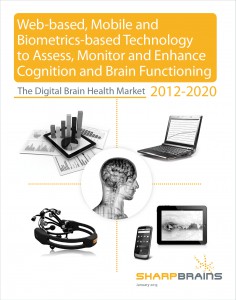
The Digital Brain Health Market 2012–2020: Web-based, mobile and biometrics-based technology to assess, monitor and enhance cognition and brain functioning
Published in January 2013, and now including a 7‑page market update dated February 2016, this 211-page market report tracks developments at over fifty public and private companies offering fully automated applications designed to assess, monitor and/ or enhance cognition and brain functioning, and provides important industry data, insights and analysis to help executives, entrepreneurs, technology/ health innovators and policy makers navigate the rapidly growing brain training and cognitive assessments field. The report discusses the technology and market opportunities arising from growing neuroscience findings on behavioral health, healthy aging, peak performance, and a number of disorders such as attention deficits, dyslexia, stroke and traumatic brain injury, schizophrenia, mild cognitive impairment, and Alzheimer’s disease. The report also provides information and frameworks to help institutions make informed investment, partnering and purchase decisions.
The report includes:
- Survey: The complete results of an exclusive SharpBrains market survey with 3,000+ respondents
- Vendor analysis: A proprietary Market & Research Momentum methodology to objectively analyze 47 technology vendors, combined with 53 in-depth company profiles
- Proprietary Market data: 2005–2012 market estimates and 2013–2020 market projections per customer segment and technology type; 8 Industry Perspectives written by key industry leaders
- Research analysis: 23 Research Executive Briefs written by leading scientists at prominent research labs
These are 10 Predictions, based on the market report, on How Digital Platforms can Transform Brain Fitness and Cognitive Assessments:
- More than one million adults in North America alone will take a self-administered annual brain health check-up via their iPad or Android tablet.
- More than one million amateur athletes will better manage possible concussions by taking cognitive baseline tests via a mobile device.
- More than 150,000 teenage and adult AAA members will access web-based brain training to become safer drivers.
- Biometrics-aided meditation will become the next big thing in corporate and consumer wellness.
- iPad-based cognitive screenings will inform more diagnoses of Alzheimer’s disease and MCI than neuroimaging.
- Patients with Multiple Sclerosis in at least 10 countries will be offered online cognitive training together with drug-based therapy to help address their condition.
- Insomnia and depression will be first-line treated with computerized Cognitive Behavioral Therapy in at least two national health services.
- The industry’s first brain-based biomarker to predict depression treatment responses will be cleared by the FDA.
- Brain training firm Lumos Labs and/or biometrics-based developer NeuroSky will file for an IPO.
- At least one major insurer will launch an educational campaign to help adults proactively take charge of their own “brain fitness” navigating emerging research and digital brain health tools.