
category archive: Author Speaks Series

Should Hamlet be living with us now and reading bestsellers, he might be wondering: 

To Blink or not to Blink?

To Think or not to Think?

We are pleased to present, as part of our ongoing Author Speaks Series, an article by Blind SpotsMadeleine Van Hecke, author of Blind Spots: Why Smart People Do Dumb Things. In it, she offers the "on the other hand" to Malcolm Gladwell's Blink argument. 


To Think or to Blink?

- By Madeleine Van Hecke, PhD

Is thoughtful reflection necessarily better than hasty judgments?

Not according to Malcolm Gladwell who argued in his best-selling book, Blink, that the decisions people make in a blink are often not only just as accurate, but MORE accurate, than the conclusions they draw after painstaking analysis.

So, should we blink, or think?

When we make judgments based on a thin slice of time – a few minutes talking with someone in a speed dating situation, for example – are our judgments really as accurate as when we analyze endless reams of data?

Continue Reading »

Daniel Goleman requires no introduction. Personally, of all his books I have read, the one I found most stimulating was Destructive Emotions: A Scientific Dialogue With the Dalai Lama, a superb overview of what emotions are and how we can put them to good use. He is now conducting a great series of audio interviews including one with George Lucas on Educating Hearts and Minds: Rethinking Education.

We are honored to bring you a guest post by Daniel Goleman, thanks to our collaboration with Greater Good Magazine, a UC-Berkeley-based quarterly magazine that highlights ground breaking scientific research into the roots of compassion and altruism. Enjoy!

- Alvaro

--------------------

Hot To Help: When can empathy move us to action?

By Daniel Goleman

We often emphasize the importance of keeping cool in a crisis. But sometimes coolness can give way to detachment and apathy.

Continue Reading »

We are fans of the Brain Science Podcast series hosted by Ginger Campbell, so are pleased to announce that Dr. Campbell will start offering to SharpBrains readers, periodically, the highlights of her most interesting podcasts. Below, her first post. Enjoy!

- Alvaro

-----------

In a recent interview on the Brain Science Podcast, Dr. John Medina, author of Brain Rules: 12 Principles for Surviving and Thriving at Work, Home, and School shared some of the practical implications of recent neuroscience research.

We talked about the importance of exercise and sleep and we discussed why appreciating how our memory and attention systems really work could change how we run schools, businesses, and even our daily lives.

For example, Continue Reading »

Larry McLeary

Try eating food with one chop stick. 

It is possible, for certain types of food. But probably not the best approach.

Let's now talk brain health.

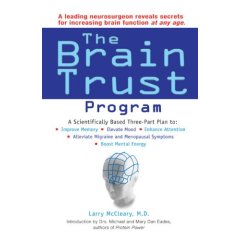
Dr. Larry McCleary is a former acting Chief of Pediatric Neurosurgery at Denver Children's Hospital, and author of the The Brain Trust Program (Perigee Trade, 2007). He agreed to help us answer an important, yet often neglected, question: Given That We Are Our Brains, How do We Nourish Them?

Alvaro: Dr. McCleary, Why did a former neurosurgeon such as yourself develop an interest in brain health public education?

Dr. McCleary: For two reasons ... I am a Boomer and am trying to maximize my own brain health. Also, there is much exciting research documenting how we can be proactive in this regard. This information needs to be disseminated and I would like to help in this process.

And what is the single most important brain-related idea or concept that you would like every person in the planet to fully understand?

The most important take home message about brain health is that we now know that no matter what your brain status or age, there is much you can do to significantly improve brain function and slow brain aging. Based on emerging information, what is especially nice is the fact that unlike many things in life our brain health is largely under own control.

What are the most important elements to nourish our brains as we age?

I approach this question much like an athlete prepares for competition. They utilize a holistic approach. Continue Reading »

It happens. Often.     

Why?

We just secured an interview with Ori Brafman, co-author of Sway: The Irresistible Pull of Irrational Behavior (Doubleday Business, 2008), to discuss our Dark Side (well, he calls it "different hidden forces" and "psychological undercurrents").

While reading some reviews about his book, I particularly enjoyed finding, after the usual impressive long collection of endorsements, this "disclaimer":

*DISCLAIMER: If you decide to buy this book because of these endorsements, you just got swayed. One of the psychological forces you'll read about in Sway is our tendency to place a higher value on opinions from people in positions of prominence, power, or authority. (But you should still buy the book.)

Continue Reading »

We sometimes neglect to mention a very basic yet powerful method of cognitive and emotional development, for children and adults alike: Play.

Dr. David Elkind, author of The Power of Play: Learning That Comes Naturally, discusses the need to build a more "playful culture" in this great article The Power of Play And Learningbrought to you thanks to our collaboration with Greater Good Magazine.

- Alvaro

--------------------

Can We Play?

-- By Dr. David Elkind

Play is rapidly disappearing from our homes, our schools, and our neighborhoods. Over the last two decades alone, children have lost eight hours of free, unstructured, and spontaneous play a week. More than 30,000 schools in the United States have eliminated recess to make more time for academics. From 1997 to 2003, children's time spent outdoors fell 50 percent, according to a study by Sandra Hofferth at the University of Maryland. Hofferth has also found that the amount of time children spend in organized sports has doubled, and the number of minutes children devote each week to passive leisure, not including watching television, has increased from 30 minutes to more than three hours. It is no surprise, then, that childhood obesity is now considered an epidemic.

But the problem goes well beyond obesity. Decades of research has shown that play is crucial to physical, intellectual, and social-emotional development at all ages. This is especially true of the purest form of play: the unstructured, self-motivated, imaginative, independent kind, where children initiate their own games and even invent their own rules.

Continue Reading »

Last December we launched brain books our stimulating Author Speaks Series to provide a platform for leading scientists and experts writing high-quality brain-related books to share their insights with SharpBrains readers. Participants so far include (in order of appearance):


Continue Reading »

One of the most original minds we have ever encountered is that of Robert Sapolsky, the Stanford-based primate (plus neuroscientist, primatologist, author of A Primate's Memoir, and more). We highly recommend most of his books. Above all, for anyone interested in brain health, this is a must read (and very fun): Why Zebras Don't Have Ulcers- Robert SapolskyWhy Zebras Don't Get Ulcers: An Updated Guide To Stress, Stress Related Diseases, and Coping.

We are honored to bring you a guest Article Series by Robert Sapolsky, thanks to our collaboration with Greater Good Magazine, a UC-Berkeley-based quarterly magazine that highlights ground breaking scientific research into the roots of compassion and altruism.

Enjoy this first installment, out of three. Very timely given the so-called "war on terror". Come back on Saturday April 12th for the second one, or subscribe to our RSS or newsletter to keep in the loop. 

- Alvaro

-----------------

Peace Among Primates

Anyone who says peace is not part of human nature knows too little about primates, including ourselves.

--By Robert M. Sapolsky

It used to be thought that humans were the only savagely violent primate. “We are the only species that kills its own,” narrators intoned portentously in nature films several decades ago. That view fell by the wayside in the 1960s as it became clear that some other primates kill their fellows aplenty. Males kill; females kill. Some use their toolmaking skills to fashion bigger and better cudgels. Other primates even engage in what can only be called warfare—organized, proactive group violence directed at other populations.

Yet as field studies of primates expanded, what became most striking was the variation in social practices across species. Yes, some primate species have lives filled with violence, frequent and varied. But life among others is filled with communitarianism, egalitarianism, and cooperative child rearing. Continue Reading »

Interested a good, non-technical, summary of the implications of recent brain science in Brain Rules-John Medinaour daily lives? Biologist John Medina offers that in his article below (as part of our Author Speaks Series) and in his new book: Brain Rules: 12 Principles for Surviving and Thriving at Work, Home, and School. Enjoy!

(Note: John will be in the Bay Area on April 8 and 9th, speaking at Google and San Jose Rotary).

----------------------

Brain Rules

-- By John Medina

Go ahead and multiply the number 8,388,628 x 2 in your head. Can you do it in a few seconds? There is a young man who can double that number 24 times in the space of a few seconds. He gets it right every time. There is a boy who can tell you the exact time of day at any moment, even in his sleep. There is a girl who can correctly determine the exact dimensions of an object 20 feet away. There is a child who at age 6 drew such lifelike and powerful pictures, she got her own show at a gallery on Madison Avenue. Yet none of these children could be taught to tie their shoes. Indeed, none of them have an IQ greater than 50.

The brain is an amazing thing.

Continue Reading »

As part of our ongoing Author Speaks Series, we are honored to present today this excellent article by Dr. Shannon Moffett, based on her illuminating and engaging book. Enjoy!

(and please go to sleep soon if you are reading this late Monday night).
------------

Two years ago I finished a book on the mind/brain, called The Three Pound Enigma: The Human Brain and the Quest to Unlock its MysteriesShannon Moffett-Three Pound Enigma . Each chapter profiles a leader in a different aspect of mind/brain research, from neurosurgery to zen Buddhism, from cognitive neuroscience to philosophy of mind. One of my subjects was Dr. Robert Stickgold, a zany, hyper-intelligent mensch of a Harvard sleep researcher. When I met him, I was in medical school and having a grand old time—I’d exacted an extension of my tenure beyond the customary four years, so I had enough time to write the book, do my coursework, and have a life. I was busy, but still got enough sleep, had time to exercise daily, and even went for dinner and a movie sometimes. Although I found Stickgold’s work interesting, there was a part of me that just didn’t get it.

Fast-forward to the present, when I am a resident in emergency medicine at a busy inner-city trauma center; I have two-year-old twins and a husband with a 60-hour-a-week job of his own. I do not exercise. I do not eat unless I can do something else productive at the same time, and even when I do get to sleep in my own bed, my slumber is fractured by the awakenings of two circadianly disparate toddlers. It seems to take me twice as long to “get” new concepts as it used to, and I never feel like I’m functioning at top speed. In short, I am a mess. And NOW I get what Stickgold’s work is all about, and understand that he is both quantifying and explaining exactly what I’m feeling.

Continue Reading »

- Next »