Top 10 Quotes on Lifelong Neuroplasticity and Neurogenesis (and a Call to eBook Readers)
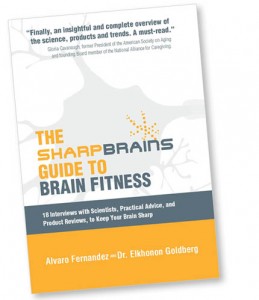
 You may have noticed that Amazon.com is sharing aggregated data on how ebook readers interact with the books they are reading. For example, the “Popular Highlights” section (towards the bottom of our Kindle book page) ranks the Top 10 sentences that Kindle readers have highlighted and shared while reading The SharpBrains Guide to Brain Fitness: 18 Interviews with Scientists, Practical Advice and Product Reviews, to Keep Your Brain Sharp (April 2009; 182 pages; ranked #1 in Kindle Store’s Preventive Medicine section).
This information is invaluable to authors and publishers — as you can imagine, we’ll make sure to not only maintain but to elaborate on these topics as we prepare future editions of the book.
So, what are so far the Top Ten Quotes on Lifelong Neuroplasticity and Neurogenesis, based on readers’ reaction to The SharpBrains Guide to Brain Fitness via Kindle eBook platform? Here you are the Top Ten:
- “Neuroplasticity refers to the lifelong capacity of the brain to change and rewire itself in response to the stimulation of learning and experience. Neurogenesis is the ability to create new neurons and connections between neurons throughout a lifetime.” (Highlighted and shared by 24 Kindle readers)
- “…best defenses against chronic stress are physical exercise, relaxation, self-empowerment, and cultivating social networks.”
- “Learning is thought to be “neuro-protective.” Through neuroplasticity, learning increases connections between neurons, increases cellular metabolism, and increases the production of nerve growth factor, a substance produced by the body to help maintain and repair neurons.”
- “There is not one single “attention”, but three separate functions of attention: alerting, orienting, and executive attention.”
- “The fear of failing, the fear of looking not smart, is a key obstacle to learning that I see too often, especially with people who want to protect perceived reputations to such an extent that they do not let themselves try new learning cycles.”
- “Emotion is the system that tells us how important something is. Attention focuses us on the important and away from the unimportant things. Cognition tells us what to do about it. Cognitive skills are whatever it takes to do those things.”
- “As little as three hours a week of brisk walking has been shown to halt, and even reverse, the brain atrophy (shrinkage) that starts in a person’s forties, especially in the regions responsible for memory and higher cognition. Exercise increases the brain’s volume of gray matter (actual neurons) and white matter (connections between neurons).”
- “Evidence of neuroplasticity has been observed mostly in the brains of individuals who became experts in a particular skill. Why? Because changes associated with learning occur massively when we become expert in a specific domain. The areas of the brain that support the skills at which one has become an expert change over time.”
- “Current recommendations suggest that a brain-healthy life style should include at least balanced nutrition, stress management, physical exercise, and brain exercise.”
- “it is also important to maintain emotional connections. Not only with ourselves, to have self-confidence and self-esteem, but also with our family our friends.” Sleep and overall health conditions are other factors that also matter. Here we focus on the four main pillars of brain health: Balanced nutrition Stress management, Physical exercise, Mental stimulation.”
We have not yet figured out whether we’ll be able to track this same data via other eBook platforms such as Barnes & Noble’s Nook and Apple’s iPad. In any case, fascinating times! If you happen to have a Kindle (or read Kindle books via other devices), and can invest $4.99 in a pretty solid eBook…please get your own copy and make sure to highlight your favorite sentences so we can include them in our analysis!
(If you don’t read eBooks but want to share your favorite book sentences with us, please do so via this Contact Us form.)
To Learn More and Order Book (most of these stores offer the ebook edition at $4.99 or equivalent, and the softcover edition at $14.95 or equivalent):
- USA (Kindle): The SharpBrains Guide to Brain Fitness (Amazon.com)
- USA (Nook): The SharpBrains Guide to Brain Fitness (Barnesandnoble.com)
- USA: The SharpBrains Guide to Brain Fitness (Smashwords.com)
- UK: The SharpBrains Guide to Brain Fitness (Amazon.co.uk)
- Canada: The SharpBrains Guide to Brain Fitness (Amazon.ca)
- Germany: The SharpBrains Guide to Brain Fitness (Amazon.de)
- France: The SharpBrains Guide to Brain Fitness (Amazon.fr)
- Spain: The SharpBrains Guide to Brain Fitness (Amazon.es)
- Italy: The SharpBrains Guide to Brain Fitness (Amazon.it)
- Libraries and booksellers can order book via Baker & Taylor
Share this:

About SharpBrains
Top Articles on Brain Health and Neuroplasticity
Top 10 Brain Teasers and Illusions
Got the book?