Lie to Me, Paul Ekman and Biofeedback
You may have watched the new series Lie To Me, with Tim Roth, based on the work of Paul Ekman.
The second episode, which you can watch for free via Hulu.com Here, is pretty interesting, but the best part happens in the beginning, so you only need to watch a few minutes to learn why what are called “lie detectors” are nothing but biofeedback systems that measure physiological anxiety.
Biofeedback can be a very effective training tool for emotional self-regulation and stress management, precisely because it enables a faster feedback-based learning loop. Indeed, we are seeing a growing number of applications in the market, with names such as EmWave, StressEraser, RESPeRATE, Journey to the Wild Divine, and others.
Simply, don’t believe the technology is an effective lie detector.
Caroline and I wrote an article on Paul Ekman’s work a couple of years ago — let me republish it now, given his work has made it all the way to mainstream TV!
 |
Paul Ekman has conducted extensive research on identifying emotions through facial expressions. As part of that research, and as part of the power of discipline and training, he learned how to consciously manipulate 42 facial muscles, including many that in most of us are beyond our control, and even awareness. |
In the 60s and 70s when Ekman began looking into the universality of facial expressions, all the major contemporary social scientists, like Margaret Mead, believed that expressions were culturally learned, not innate. He traveled all over the world with pictures of people making distinct facial expressions and found people in cultures everywhere, from modern to stone age, agreed on the emotion behind the expression. He then turned to studying the production of these expressions and the 43 facial muscles that can create 10,000 expressions, which form the basis of his training.
He found seven universal emotions with unique facial expression. The emotions are: anger, fear, sadness, disgust, happiness, surprise, and contempt. At least five of these are shared with non-human primates as well. Interestingly, the smile is the easiest expression to recognize, and the easiest to identify from afar. These emotions have a specific trigger, come quickly without thought, and interact with your physiology — meaning merely making the fear expression will create a fear response in your body as well. With fear, neurons will signal your body to prepare to flee by sending blood to the large voluntary muscles in your legs. In anger, on the other hand, your brain signals your body to fight by sending blood to your hands. Try practicing on yourself: can you feel a change in your emotional state by making changes in your facial expression?
Emotions have distinct triggers and learning those triggers is an important step in understanding your own emotions and why you respond the way you do. To date, the best way to learn to recognize the the impulse that was triggered before the awareness of the emotion is contemplative practice (meditation). Also, an important point to clarify, emotions are not moods, which are longer affective experiences have an unclear trigger (you may not be sure what sparked the mood you’re in) and tend to filter your view of the environment.
Based on primary and secondary research, he found that there are seven emotions expressed in the face in universally consistent ways:
— Sadness
— Anger
— Surprise
— Fear
— Enjoyment
— Disgust
— Contempt
Even more interesting: according to his research, feelings and facial expressions influence each other. This is, not only a sad person will naturally look sad, but a person who intentionally smiles will feel more content than a person who doesn’t.
You can read his advice on how to recognize feelings in order to communicate better (opens a PDF document), focused on doctor-patient relationships but useful to everyone (including patients who may want to make sure to get their point across).
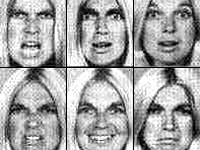
Question: from left to right, top then down, what universal feeling does each face indicate?
Share this:

About SharpBrains
Top Articles on Brain Health and Neuroplasticity
Top 10 Brain Teasers and Illusions
Got the book?