

What You Can do to Improve Memory (and Why It Deteriorates in Old Age)
After about age 50, most people begin to experience a decline in memory capability. Why is that? One obvious answer is that the small arteries of the brain begin to clog up, often as a result of a lifetime of eating the wrong things and a lack of exercise. If that lifetime has been stressful, many neurons may have been killed by stress hormones. Given the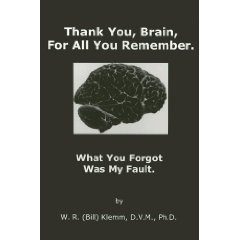 most recent scientific literature, reviewed in my book Thank You, Brain, For All You Remember. What You Forgot Was My Fault, dead neurons can’t be replaced, except in the hippocampus, which is fortunate for memory because the hippocampus is essential for making certain kinds of memories permanent. Another cause is incipient Alzheimer’s disease; autopsies show that many people have the lesions of the disease but have never shown symptoms, presumably because a lifetime of exceptional mental activity has built up a “cognitive reserve.
So is there anything you can do about it besides exercise like crazy, eat healthy foods that you don’t like all that much, pop your statin pills, and take up yoga?
Yes. In short: focus, focus, focus.
Changing thinking styles can help. Research shows that older people tend to have lost some of their ability to pay attention, which fortunately can be improved if they work at it. More specifically, older people tend to have difficulty in ignoring distractions and irrelevant stimuli. Distractions and a reduced ability to focus disrupt the consolidation process that converts working memory into long-lasting form.
In one study of this aging problem, a typical group of trials involved presenting a picture of a face for about a second, a picture of a scene for about a second, then a picture of another face for about a second, and then another picture of a different scene for about a second. Then after a nine-second delay a picture was presented and the subject was instructed to press a button to indicate whether the stimulus matched one of the previously presented stimuli. In other words, the subject had to suppress the memory of irrelevant stimuli. In this study (Gazzaley, et al. 2005) the investigators went beyond behavioral assessment of the responses, because that kind of thing had been done before. What they wanted to know was what was happening in the brain during this suppression of irrelevant task. They used functional magnetic resonance (fMRI) imaging  over a region of brain that was responsive to the visual images. What was being measured was the amount of brain activity under conditions when the instructions were to remember a type of image or ignore it. What they found was that brain activity in all of the young subjects increased when they were viewing scenes they were asked to remember and decreased when presented with an image that they were supposed to have ignored. That is, the brain suppressed its response to irrelevant stimuli. Many older participants, however, were unable to suppress brain activity when presented with stimuli that they had been asked to ignore. So what these data suggest is that older individuals have difficulty in ignoring irrelevant or distracting information that is contained in working memory. But let us not come away with the conclusion that memory deficits in the elderly are inevitable, when in fact in this study nearly half of the elderly showed no deficit.
In a study at the University of Illinois (Fabiani, M. et al. 2006.), researchers recorded brain electrical responses in young adults and old subjects (65–78) who were passively listening to bursts of sound that contained a base frequency of 500 cycles per second, with superimposed higher frequencies at lower amplitude. Sound volume was adjusted to the hearing threshold for each subject. Sound was presented while subjects were instructed to concentrate on reading a book and to ignore the sound bursts. Four bursts were delivered with variable silent intervals. The brain registered the memory of each burst in the size of the evoked electrical response. The repetition of sound burst was expected to induce suppression of the sound-evoked electrical response to later bursts in the train, while the silent interval was expected to allow for recovery as the memory of a preceding burst decays. By varying the interval, researchers could evaluate the decay process.
Results revealed that the electrical responses persisted longer in older people, but the effects of delay interval were the same irrespective of age. Since age did not seem to affect memory decay, one is left to conclude that the brains of older subjects were less able to inhibit the sound burst distractions. The good news for the elderly is that age does not make you forget any faster. It does, apparently, make you more distractible.
Such studies should probably also be done in children, who I would suspect are more like older people in being less able to inhibit distractions.
A study at the University of Toronto (Grady, C. L. et al. 2006.) used MRI imaging of people while they performed a variety of memory tasks, both during encoding and recognition. They found an age-related increase in activity in brain areas that normally decrease during task performance. This is interpreted to indicate that these areas normally do not respond during a memory task because the brain is paying attention to the task and assigning the memory work only to the parts of brain that need to process the memory. However, another interpretation is that as you get older, your brain has to recruit more help from other parts of the brain. A related finding of the research was an age-related decrease of activity in brain areas that normally become activated during the memory task. The researchers thought that this finding indicated an age-related decline in ability to distinguish task-related demands from those that were irrelevant. It could also be that as you age, the circuits that are normally needed to handle memory are less capable. However you look at it, the findings document an age-related decline in the brain’s ability to focus its neural resources on memory tasks. What may be most troublesome to contemplate is that the brain activity-pattern changes showed signs of decline around age 40.
So, what do we do about attention deficit? One possibility is that by keeping our brain working hard as we age, we might reduce this tendency to lose ability to handle memory workload. Think of it like exercise for the brain, which strengthens the neural circuits in the parts of the brain that have to distinguish irrelevant from relevant information in memory tasks and those parts of the brain that have to do the memory work. Another general strategy is to reduce the distractions in our life, at least distractions that are present when we are trying to remember something. Multi-tasking is hard enough to do when you are young. That ability probably declines markedly as you get older. On those occasions when I forget what I opened the refrigerator door for, it is always because I let myself get distracted between the time I decided what I wanted and the time when I opened the door. Obviously, older people (and children) need to work at paying attention, disciplining the brain to concentrate. Second, since they are so distractible, information should be absorbed in smaller, more manageable chunks. By lowering the memory demand, the brain’s limited resources can deal with it more effectively.
 — W. R. (Bill) Klemm, D.V.M., Ph.D. Scientist, professor, author, speaker As a professor of Neuroscience at Texas A&M University, Bill has taught about the brain and behavior at all levels, from freshmen, to seniors, to graduate students to post-docs. His recent books include Thank You, Brain, For All You Remember. What You Forgot Was My Fault and Core Ideas in Neuroscience.
Sources:
- Fabiani, M. et al. 2006. Reduced suppression or labile memory? Mechanisms of inefficient filtering of irrelevant information in older adults. J. Cognitive Neuroscience. 18 (4): 637–650.
- Gazzaley, A. et al. 2005. Top-down suppression deficit underlies working memory impairment in normal aging. Nature Neuroscience. 8: 1298–1300.
- Grady, C. L. et al. 2006. Age-related changes in brain activity across the adult lifespan. J. Cognitive Neuroscience. 18:227–241.
Share this:

2 Comments
About SharpBrains
Top Articles on Brain Health and Neuroplasticity
Top 10 Brain Teasers and Illusions
Got the book?

In a recent study completed at the University of Pennsylvania, Andrew Newberg, MD, established that a 12-minute chanting meditation improved a range of memory and cognition problems in cognitively impaired older adults. None had practiced meditation before, and the improvements ranged from 10–20% after 8 weeks of practice. Apparently, meditation “trains” the brain to be more alert, focused, and organized, and most meditation techniques affect the same neural circuitry which affects the parietal/precuneal area, the anterior cingulate, parts of the basal ganglia, and many areas in the frontal and prefrontal cortex. The paper will be published shortly and reported on in the forthcoming book, How God Changes Your Brain, to be released in March 2009.
Mark Waldman
Associate Fellow
Center for Spirituality and the Mind
University of Pennsylvania
Being a practicing meditator, the results make complete sense. Nice study.