

Travel and Engagement as Good Brain Exercise
Neuroplasticity is defined as “the ability of the brain to rewire itself through experience”.
We typically summarize a lot of brain research by encouraging SharpBrains readers is to seek for novelty, variety and challenge, as guidelines for “brain exercise” that will help build new connections in the brain, force one to be mindful and pay attention, improve abilities such as pattern-recognition, and in general contribute to lifelong brain health.
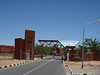
A friend just sent an update on her amazing experience in Namibia (the pic on the right shows the entrance to the University of Namibia) that shows how Travel and Engagement with meaningful projects can provide superb mental stimulation, or “brain exercise”. This is relevant at all ages, and we are encouraged to see organizations such as Civic Ventures and Elderhostel that offer opportunities for baby boomers and older adults who want to maintain active minds.
Try picturing in your mind, as you read this, all her different brain areas that are getting needed stimulation through her Namibia experience.
UPDATE: my friend just wrote to expand on the “be mindful” angle by saying that “it definitely requires purposeful processing of the information that you are consuming in order to make it a useful brain exercise. For example, I always try to journal or write thoughtful emails about my experience in order to try to best understand it.” Great point.
With her permission, here you have:
———————————-
Dear Friends,
I am just returning from Namibia and am buzzing with excitement about all of the opportunities for us to make an impact there when we return with our students next Spring.
Namibia is very different than I expected. It was the last country in Africa to gain independence from colonialism, gaining independence just 20 years ago. Thus, it is much more developed than any African country that I have visited, with relatively good infrastructure and no existing debt. That said, the legacies of apartheid can still be felt in today’s society, and the people are very clearly dealing constantly with issues of race and identity. One of the most interesting experiences that I had was attending a “braai” (the Namibian version of a barbecue which basically consists of a first course of a slab of meat, a second course of a bigger slab of meat, and a dessert of meat with sugar on top…needless to say, Barbara, our resident vegetarian, went hungry that night). At the braai were a group of young white people (social circles are still heavily segregated), none of whom were more than 30 years old, and all of whom had seen the fall of apartheid within their lifetime. While they had been born under a regime where all high-level jobs were reserved for whites, where blacks were told where to live and how to act, they were now struggling very much with what it means to be “African.” These were people who, at a very young age, had to reject their parents’ teaching that “black people are different” in order to conform with the norms of post-Apartheid society. And yet at the same time, they are still faced with situations where they are not considered “African” because of the color of their skin, in spite of the fact that all of their families have been in Africa for several generations.
The next day, we had an amazing opportunity to see the complete opposite side of the spectrum at the New Covenant Pentecostal Church of Namibia. This rocking and rolling church service takes gospel to a whole new level. And talk about dressed to the nines…when we arrived we were introduced to the pastor’s wife who very easily could have been going to a New Year’s Eve party given her sparkly attire. The African women were so glamorous, dressed head to toe in colors so bright you could see them coming from miles away. The ma ss lasted no less than four hours (my parents said I must have been making up for lost time!), and everyone in that church (ourselves included) were singing and dancing the entire time. To give you an idea, I could have yelled at the person sitting next to me at the top of my lungs and it would have gone unnoticed, I kid you not. As the rocking and rolling cooled down mid-way through, and the pastor stood up to give his sermon, it became very clear that these parishioners (who were all black) were also dealing with their own issues of identity and empowerment in the post-apartheid world. The pastor used the Bible passage where David returns to Israel to claim his land as a metaphor to preach that everyone in that church should take ownership over their own lives, and take initiative to claim their own land, be it figuratively or literally. The congregation was on the edge of their seats and, gauging by the level of engagement, the words could have bee n coming from God himself. The intermittent “hallelujahs” and “praise the lords” were constant. It was truly amazing to see this group of people who, just like the white twenty-somethings we had dined with the night before, had seen the fall of apartheid within their own lives and were so empowered and full of hope for the future. I later learned that, in fact, this community of partitioners who appeared so glamorous and together had once been quite poor. But through coming together as a community and through the positive spirit of their church leaders, they had overcome poverty, with the majority of them living comfortably in the emerging middle class of Namibia. To see the hope in these people’s eyes was one of the most inspiring experiences of my life, and makes me very excited about the work that we are going to be doing in Namibia.
While well-developed for African standards, the extreme poverty th at we associate with the developing world was not absent. One day we took a tour of Katatura, which was originally where the blacks were forced to live in separate quarters during apartheid. Beyond the evident poverty that existed in these neighborhoods were miles and miles of shanty towns that had sprung up with the onslaught of people who had come from rural areas for work in Windhoek. More than half the population of Windhoek lives in these make-shift homes, made of corrugated metal if they were lucky, or old car parts, tree branches, used billboards or anything else they could get their hands on if they were not. You can imagine the stench in the air from no running water or toilets. And the meals were sparse — most lived off of a litre of liquid a day, which was a combination of yeast, flour and water and made to be filling in spite of the fact that it might be their only meal for the day (we had a taste of it — it was some really horrible stuff). It was not my first time seeing such deep poverty, but every time I do, my Catholic guilt begins to set in, followed by a raging desire to do something about it. In my search to figure out how I could do my part to help, I found many nonprofits on the ground in Namibia doing incredible work to combat HIV/AIDS and poverty. I will not go into detail about their incredible work here, but would be happy to share if anyone is interested.
And of course, there is the reason that we were there in the first place: to develop the projects for the Stanford law students that we would be bringing in the Spring. Given Barbara’s past work in Namibia, we were lucky to have access to many of the key players who are building the democracy in this country. Meeting these inspired individuals made me think of what it would have been like to go back in time to meet our own founding fathers. Like the founders of our own democracy, these are people who have a vision for making Namibia a model for democracy around the world. They have the advantage of being able to see how other democracies have emerged and to learn from their failures. Namibia wants more for their country. On a continent that has seen some of the worst human rights abuses in recent decades, Namibia wants to set the standard. Some of the projects that we will be working on in order to help them get there are researching and drafting legislation to implement the Convention Against Torture, bringing a claim for land on behalf of the San people in the northern part of the country, assisting in the implementation of customary tribal law into the judicial system, and developing a project that builds the capacity of the judiciary to communicate amongst themselves, thereby improving consistency of precedent in their common law system. I am really energized about all of the work that we will be doing over the coming months and have no doubt that it will be an incredible experience for all those involved (myself included).
I hope that you all share with me in remembering how very lucky we are during this holiday season.
Happy holidays and a joyous new year!
Lots of love,
K
———————————-
Reactions?
Share this:

4 Comments
About SharpBrains
Top Articles on Brain Health and Neuroplasticity
Top 10 Brain Teasers and Illusions
Got the book?
Just reading your friend’s letter is already enough to stimulate my brain. I don’t have to be in Africa to think about the differences in every culture. Just from the letter itself, I have found myself becoming a bit involved with the situation in Namibia. It gave way for a truly sincere reflection.
Hello Jay, happy that the post was useful!
Not only does prolonged International travel stimulate the mind it also allows you to see the world through a different paradigm
Great point. That change of paradigm is precisely what stimulates the mind, and helps create a variety of new connections in the brain, in a deeper way than, say, do one more crossword puzzle, or take on one more familiar work challenge.