10 Highlights from the 2007 Aspen Health Forum
 The Aspen Health Forum gathered an impressive group of around 250 people to discuss the most pressing issues in Health and Medical Science (check out the Program and the Speakers bios), on October 3–6th. It was the first conference, by the way, where I have heard a speaker say: “I resuscitated a woman yesterday”.
Key highlights and trends:
1- Global health problems require the attention of the scientific community. Richard Klausner encouraged the scientific community to focus on Global Problems: maternal mortality rates, HIV/ AIDS, nutrition, cancer, clean water. Bill Frist, former Senate Majority Leader, added to that list the increasing epidemic risks of global zootic diseases (transmitted between humans and animals), supported by 2 interesting data points: at any one moment, there are 500,000 people flying worldwide; in a year, airlines transport the equivalent of 2 billion passengers.
2- “Let’s get real…Ideology kills”. Mary Robinson, former President of Ireland, on what it takes to stop HIV/ AIDS: “I am from Ireland, a Catholic country. And I am Catholic. But I can see how ideology kills..we need more empathy with reality, and to work with local women in those countries who need things like female condoms.” She was implicitly criticizing the large budget devoted to unrealistic abstinence programs. This session included a fascinating exchange where Bill Frist rose from the audience to defend the role of US aid, explaining how 60% of retroviral drugs in African countries have been funded by the American taxpayer, highlighting President Bush’s courage to make HIV/AIDS a top agenda item in many developing countries, and criticizing other countries for not doing enough. Which made Nobel Prize Laureate Peter Agre, also in the audience, stand up and encourage the US to really step up to the plate and devote 1% of the GDP to aid, as a number of European countries do, instead of 0.1%.
3- Where is the new “Sputnik”?: Basic science is crucial for innovation and for economic growth, but it is often underappreciated. Scientists are not “nerds”, as sometimes they are portrayed in popular culture, but people with a deep curiosity and drive to solve a Big problem. Many of the speakers had been inspired by the Sputnik and the Apollo missions to become scientists, at a time when the profession was considered cool. Two Nobel Prize Laureates (Peter Agre, Michael Bishop), talked about their lives and careers trying to demystify what it takes to be a scientist and to win a Nobel Prize. Both are grateful to the taxpayers dollars that funded their research, and insist we must do a better job at explaining the  scientific process to society at large. Both are proud of having attended small liberal arts colleges, and having evolved from there, fueled by their great curiosity and unpredictable, serendipitous paths, into launching new scientific and medical fields. Bishop listed a number of times where he made decisions that were considered “career suicide” by mentors and colleagues, and mentioned “I was confused” around 15 times in 15 minutes…down to earth and inspiring.
4- We need a true Health Care Culture: Mark Ganz summarized it best by explaining how his health provider group improved care when they redefined themselves from “we are 7,000 employees” to “we are a 3 million strong community”, moving from being a cost controller with a paternalistic attitude to a health facilitator, looking underneath symptoms to identify and deal with underlying patterns. Mark also announced the launch of the Aspen Health Stewardship Project to 1) identify levers to change the culture of control, 2) frame the upcoming political health care debate, 3) create a reportcard to screen all political proposals. Will be interesting to check the progress of the initiative in next year’s conference.
Related to this, there were panels on how to improve Medical Education, including training doctors to be members of a team and improve patient-based problem solving and “soft skills” such as how to apologize to patients and their families. And on Electronic Medical Records, that have proven to reduce medical mistakes and overall healthcare system costs, yet many physicians resist their use due to the time required to fill out the online forms and workflow changes required. An interesting data point: in 65% of visits to the doctor these days, patients bring something printed from the internet.
5- You can’t manage what you can’t measure. We heard many times how defining and measuring outcomes, so common in the private sector, is critical to ensuring a good allocation of resources in the health and scientific fields, that use so much taxpayer money. For example. NIH funding grew from $9B in 1994 to $29B in 2007, yet the results are not clear. The same happened with health care as a whole, a sector that now consumes 16% of the US GDP with health outcomes (infant mortality, patient deaths in hospitals) worse than other countries that invest far less. There is an apparent consensus that science and healthcare need more resources but will only get them once they clean house.
6- The rising role of public-private partnerships: There are multiple initiatives launched to bridge the increasing gap between academia and industry. The Foundation for the NIH has facilitated key conversation between the FDA and pharma companies. The Gates and Clinton Foundations have launched innovative partnership models to tackle global health problems. The Myelin Repair Foundation was launched to build bridges once its founder, who had “assumed someone had a plan”, discovered that little progress had happened in 20 years to help patients with multiple sclerosis.
7- From Lifespan to Health-span. Population distribution in developed countries is shifting from a “population py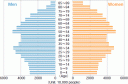 ramid” to a “population rectangle” (see Japan population “pyramid”, right). There was a good deal of emphasis on the biology of aging and healthy aging, both on how the environment can regulate gene activation and on genetics. Cynthia Kenyon, a UCSF researcher showed her research on how disabling one specific gene in a worm can double that worm’s lifespan, and mentioned how that study has been replicated with fruit flies and mice, and could, conceptually, help humans live longer & healthier lives. The point of much ongoing research is not “how to spend more time on the nursing home” but how to slow down the process of aging, so we can live healthier longer.
8- Patient-advocacy groups are having an impact. We heard many examples on how small groups of motivated individuals have built large patient advocate movements that influence public policy. Michael Milken talked about the Cancer March, that helped increase NIH funding from $1.5B to 5$B. Hala Moddelmog, from the Susan G. Komen for the Cure, explained how they have 1 million people engaged in promoting cancer research and prevention. Robert Klein, key advocate of the California Proposition 71 (that will provide $6B for stem cell research through long-term bonds) explained how the proposition was passed, including engaging over 80 patient-advocacy groups.
9- There’s a new emphasis on understanding “how systems work” instead of “how isolated genes make things happen on their own”: Genomics is starting to help predict susceptibility to disease and to therapies. Now, we must remember the difference between strong and weak genes (only specific combinations of which may create predispositions), and keep in mind the role of our experience and environment in turning some genes on or off. Regis Kelly provided a wonderful overview of neuroimaging, learning and neuroplasticity, and highlighted how many biologists are moving from thinking about “how genes make things happen” to “how systems work”, given than in humans manipulating just one gene may trigger changes in 500 others.
10- The importance of our Lifestyle-Each of us owns our own health. 70% of heathcare costs derive from lifestyle-related diseases (such as smoking-induced cancer). We heard several calls to action for insurance companies to incentivize behavior modification to promote good lifestyle habits that improve quality of life and can delay disease symptoms, resulting in billions of dollars of cost savings. Yet, in my view, the discussion was too conceptual in this area, and not specific or action-oriented enough.
In short, a very stimulating inaugural 3‑day conference. I hope the one next year is even better, and includes more in-depth conversations on the role of prevention and lifestyle in driving health outcomes, and builds more bridges with neuroscience and psychology. I would suspect the topics discussed in our Neuroscience Interview Series will have significant implications on the growing healthcare and prevention debate.
Update: you may enjoy the post The Alfred Nobel legacy: 2007 Nobel Prizes.
Share this:

About SharpBrains
Top Articles on Brain Health and Neuroplasticity
Top 10 Brain Teasers and Illusions
Got the book?