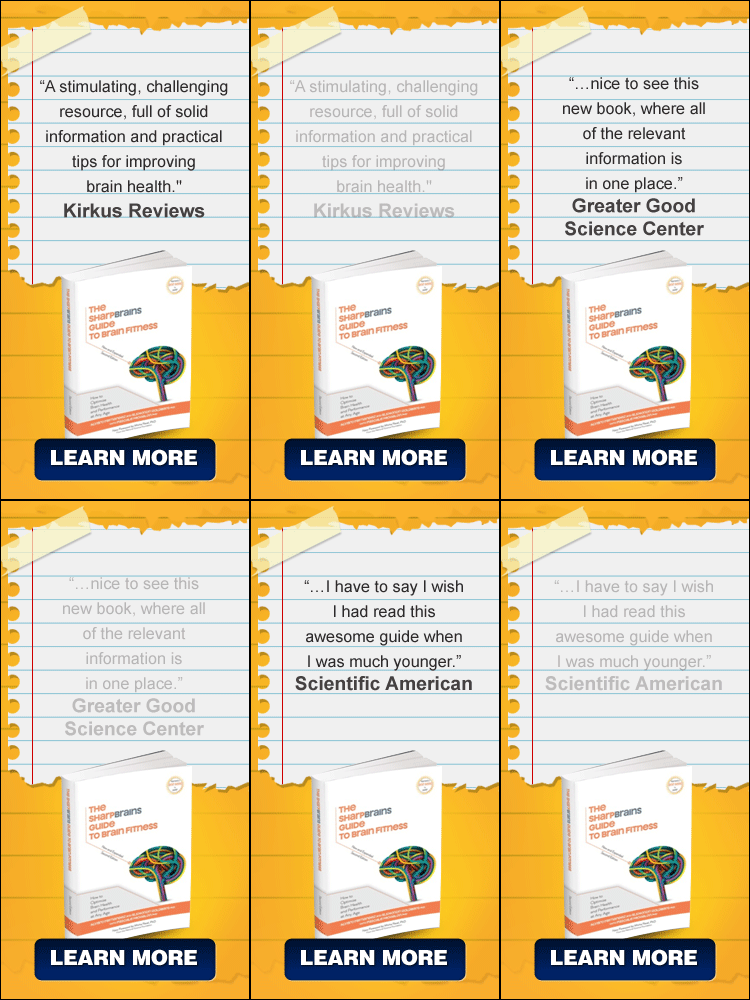
GABA Receptor
Steven Edwards at Wired Blog writes a post titled Yoga Boosts Brain's GABA Levels, saying that "Participants in the yoga group had a 27% increase in GABA levels, while those in the reading group remained unchanged. Co-authors Chris Streeter from BUSM and Domenic Ciraulo pointed out that this research shows a method of treating low GABA states. Fairly obvious --- yes --- but this shows a nonpharmacological method for increasing GABA levels that people can act on now, without waiting for a drug to go through FDA approval."

Having attended last week a conference where neuropharma executives presented all their future drugs against obesity, anxiety, depression...I couldn't agree more. The rates of serious side effects of these drugs are astounding, yet as a society we seem to prefer to rely on taking drugs when are sick rather than proactively taking charge of our health and lifestyles and do our best (which not always is enough) to protect our fitness and wellness.

The press release Steven talks about: Yoga and Elevated Brain GABA Levels [PhysOrg]. Quotes:

  • "Researchers at Boston University School of Medicine (BUSM) and McLean Hospital have found that practicing yoga may elevate brain gamma-aminobutyric (GABA) levels, the brain's primary inhibitory neurotransmitter. The findings, which appear in the May issue of the Journal of Alternative and Complementary Medicine, suggest that the practice of yoga be explored as a possible treatment for depression and anxiety, disorders associated with low GABA levels."
  • "The development of an inexpensive, widely available intervention such as yoga that has no side effects but is effective in alleviating the symptoms of disorders associated with low GABA levels has clear public health advantage," added senior author Perry Renshaw, MD, PhD, director of the Brain Imaging Center at Harvard-affiliated McLean Hospital.

Related posts:

Are yoga and meditation good for my brain?

Stress Management Workshop for International Women's Day

Bill Clinton on health care and wellness

13 Responses to “Yoga and stress management”
  1. Vertegramon 27 May 2007 at 12:21

    The Personal Development Carnival - May 27, 2007...

    Welcome to the May 27, 2007 edition of the personal development carnival!
    This is the first carnival hosted at Vertegram. It was thrilling to see so many excellent posts being submitted. Thanks for you all!

    Victor Fam presents Towards a Better Life Ar...

  2. [...] 11) Are you addicted to the "latest" medicines in order to help you get by in life? If so, or if you know someone who is, be sure to check out the post Yoga and Stress Management over at Brain Fitness. Turns out there may be a much better way to deal with some common ailments! [...]

  3. [...] In the same vein, Alvaro Fernandez discusses yoga's positive effect on brain chemistry in Yoga and stress management posted at Brain Fitness. Ananga explores the mind-body connection in Word Association: How Your Mind Walks Your Talk posted at Ananga Sivyer's Living by Design Blog. [...]
  4. [...] Alvaro Fernandez presents Yoga and stress management posted at SharpBrains, saying, "How yoga can help build our brains" [...]

  5. [...] Alvaro Fernandez presents Yoga and stress management posted at SharpBrains, saying, "How yoga can help build our brains" [...]

  6. [...] Alvaro Fernandez presents Yoga and stress management posted at SharpBrains, saying, "The possibilities of using a non-invasive treatment with few side effects, like yoga, to help with depression, anxiety, and other disorders with low GABA levels are exciting." [...]

  7. [...] Alvaro posted a study on potential pharmacologic effects of Yoga as it relates to stress management; now there's an alternative therapy with an excellent side effect profile when compared with medication therapy given the appropriate patient type (i.e. not acutely and severely depressed patients who require immediate medical help). [...]

  8. [...] Steven Edwards at Wired Blog writes a post titled  Yoga Boosts Brain's GABA Levels , saying that "Participants in the yoga group had a 27% increase in GABA levels, while those in the reading group remained unchanged. Fairly obvious --- yes --- but this shows a nonpharmacological method for increasing GABA levels that people can act on now, without waiting for a drug to go through FDA approval. The rates of serious side effects of these drugs are astounding, yet as a society we seem to prefer to rely on taking drugs when are sick rather than proactively taking charge of our health and lifestyles and do our best (which not always is enough) to protect our fitness and wellness. The findings, which appear in the May issue of the Journal of Alternative and Complementary Medicine , suggest that the practice of yoga be explored as a possible treatment for depression and anxiety, disorders associated with low GABA levels. read more... [...]

  9. Daily healthy living tipson 02 Jul 2007 at 10:53

    Managing the stress: coping better with changes i...

    Sources. Any kind of changes in your life can be a source of stress including the positive one like job promotion. Stressor is also unique to each personmeaning that what is stressful to you might not affect other people. Common source of stress incl.....

  10. Pamela McDowellon 06 Jul 2007 at 2:45

    Yoga could make you happier.

    Ok, to anyone who regularly practices yoga, this is not news. But this new study gives some bio-chemical reason for why yoga can make you feel happier and calmer.

    ....So, increased brain GABA levels may be why previous studies have found that yoga helps improve depression, anxiety, and epilepsy....

  11. Alvaroon 07 Jul 2007 at 1:13

    Hi Pamela,

    There are a number of benefits from yoga, on its own and as a great stress management technique, that go beyond GABA levels. But it is great to better understand what is going on, and be able to have a better picture of what specific techniques are better for what goals. Kind regards

  12. » Yoga and stress managementon 10 Nov 2007 at 8:10

    [...] You can read the rest of this blog post by going to the original source, here [...]

  13. [...] You can read the rest of this blog post by going to the original source, here [...]

Trackback URI | Comments RSS

Leave a Reply