Want to Improve Memory? Strengthen Your Synapses.
Newswise released an article called “Want to Improve Memory? Strengthen Your Synapses. Here’s How.” based on findings findings published in the February issue of Mind, Mood and Memory, a newsletter from Massachusetts General Hospital, a leading center of excellence in the field of cognitive fitness. Essentially, they explain how a decline in the health of neuronal synapses can lead to a decline in memory and general mental fitness.
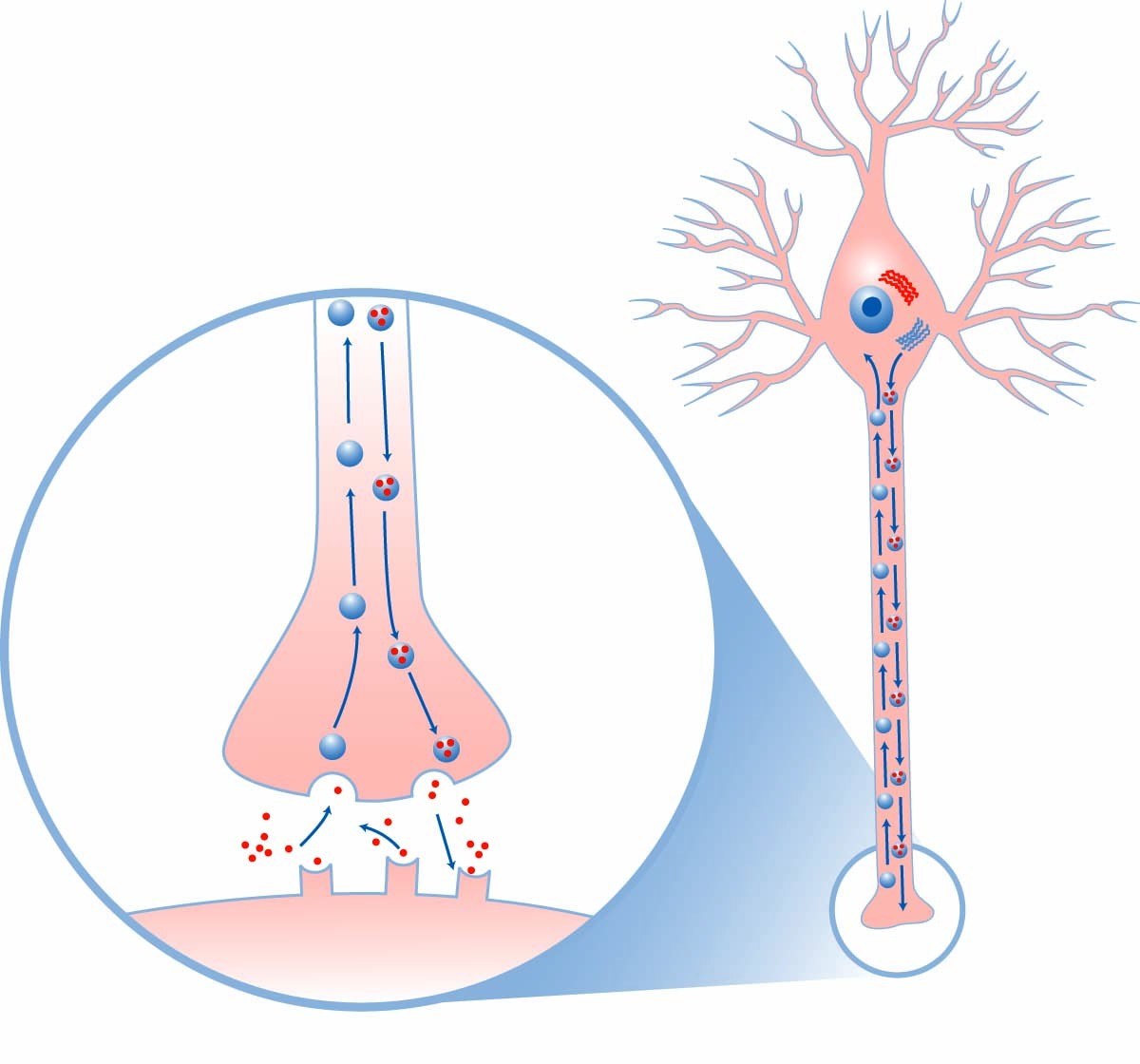
For those you aren’t familiar with synapses, they are the spaces between neurons where the electrical signal traveling down from the tree-like dendrites at the top of the cell through the cell body and down the tubular axon changes into a chemical signal (neurotransmitter) to talk to neighboring cells. In this picture from the article, the neurotransmitter is represented by the red dots. We have more than 100 billion neurons that can be connected to hundreds of other cells by as many as 10,000 synapses.
Here are a few good quotes from the article …
New information is absorbed and retained through a process characterized by changes in synaptic interconnections among neurons in the hippocampus and cerebral cortex, regions of the brain associated with memory. But the ability to learn and remember, along with other mental and emotional processes, can be influenced by the effects of lifestyle and environment on the synapses. Studies suggest that neurons that are adversely affected by factors such as stress, lack of stimulation, or neurotoxins may be hampered in their ability to form new patterns of connectivity and may lose synaptic connections.
It is generally agreed that learning occurs when the acquisition of new information causes synaptic changes, but scientists are not yet certain precisely how these changes come about. Several theories have been proposed. In one, called the Hebbian theory, it is thought that any two cells or systems of cells that are repeatedly activated at the same time will tend to become “associated,†so that activity in one makes it more likely the other will become active. Repeated co-activation of connected cells is thought to make physical changes in the brainâ€â€such as the development of new synapses between neurons or more receptors in the post-synaptic membraneâ€â€that lead to a lasting memory.
The article concludes with these recommendations to help you keep your mind active and alert:
- Reduce stress: Make time for leisure activities. Learn relaxation techniques such as meditation. Cut down on unnecessary responsibilities and avoid over-scheduling.
- Stimulate your brain: Avoid routine. Enjoy new sensory experiences. Challenge your mind and body with new situations.
- Exercise: A brisk walk or other cardiovascular workout oxygenates the brain and promotes brain growth factors.
- Challenge your mind: Tackle puzzles, games and demanding intellectual tasks. Make an effort to learn new information through classes or reading.
- Stay healthy: Eat a nutritious diet, get adequate sleep, avoid smoking, and if you use alcohol, drink in moderation.
Share this:

About SharpBrains
Top Articles on Brain Health and Neuroplasticity
Top 10 Brain Teasers and Illusions
Got the book?