homunculus

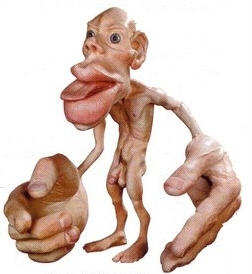
Who, or what is this? Why are we talking about him? Let me give you a clue: his name in Homunculus.

The answer is posted as a Comment.

27 Responses to “Brain exercise: who is this?”
  1. Alvaroon 04 Oct 2006 at 11:37

    Watch this fun short animation:

    http://faculty.washington.edu/chudler/flash/hom.html

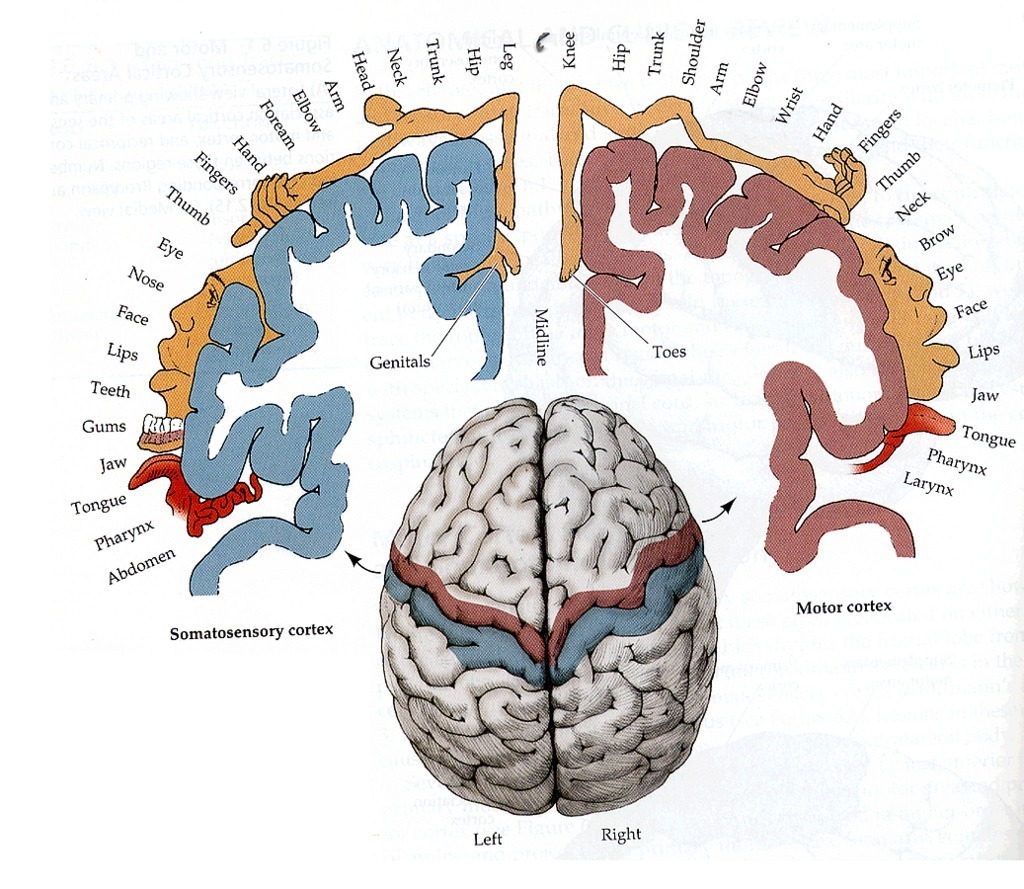
    In short, the figure shows what a man's body would look like if each body part kept proportion to the area of the cortex of the brain involved with its sensory perception.

  2. eleanoron 05 Oct 2006 at 2:28

    that is hilarious! - I was mildly apprehensive about whether or not they would omit certain body parts - particularly if it was for kids to see - but they cunningly glossed over the issue!

  3. Alvaroon 05 Oct 2006 at 8:18

    Yes, I had to be careful :-)

  4. avk raoon 02 Dec 2006 at 9:06

    The funny face looks like a funny figure from AESOPES FABLES OR ARABIANNIGHTS
    BUT MAY REPRESENTA STAGE IN EVOLUTIN OFMAN BETWEN APE AND HOUS ERECTUS-A V K RAO

  5. Alvaroon 03 Dec 2006 at 11:51

    Hi A V K, please check the little animation and enjoy it :-)

  6. [...] 5. Who is this?: A very important little guy [...]

  7. [...] 5. Who is this?: A very important little guy [...]

  8. e22on 28 Aug 2007 at 1:26

    he is the little man in your head that causes all your visual activities.

  9. Alvaroon 28 Aug 2007 at 8:50

    e22: please check the visual animation :-)

    http://faculty.washington.edu/chudler/flash/hom.html

  10. Rodrigo Fuenzalidaon 07 Oct 2007 at 11:51

    This ugly and deformed man is a representation of the degree of sensitivity of the surfaces of our body, in means of the amount of cortex dedicated to each. The most bigger body parts are the mor sensitive, like the lips and hands. The smaller ones are the ons that require the less sensitivity of all, like our legs and back.

  11. Alvaroon 07 Oct 2007 at 3:37

    Great explanation, Rodrigo, thanks.

  12. [...] 3. Who is this?: A very important little guy (Interactive). [...]

  13. joeon 17 Oct 2007 at 10:27

    ummmm...this isn't a brain exercise of any kind, it's a trivia question.

  14. [...] 3. Who is this?: A very important little guy (Interactive). [...]

  15. FreeBeeon 18 Oct 2007 at 6:47

    Now THAT explains why kissing is so effective. See the size of the mouth, especially the lips.
    Touching a fellow human being, by design, is something pleasurable, because we need that for reproduction. Kissing might be considered just another form of touching, but its effect is so much stronger than that of most other activities.

  16. Alvaroon 18 Oct 2007 at 7:00

    Great point, FreeBee

  17. Beachgirlon 22 Oct 2007 at 10:33

    The homunculus is also commonly used to describe the distorted human figure drawn to reflect the relative space our body parts occupy on the somatosensory cortex (sensory homunculus) and the motor cortex (motor homunculus). The lips, hands, feet and sex organs have more sensory neurons than other parts of the body, so the homunculus has correspondingly distortedly large lips, hands, feet, and genitals. Well known in the field of neurology, this is also commonly called 'the little man inside the brain.'

  18. Beachgirlon 22 Oct 2007 at 10:36

    I saw the same animation last night on a show called "In the Living Body" on the National Geographic channel.

  19. Alvaroon 24 Oct 2007 at 8:17

    Hello Beachgirl: thanks for the head up!

  20. Jazzon 06 Nov 2007 at 8:40

    It is the species of man before evolving into homo sapeans

  21. Alvaroon 06 Nov 2007 at 7:48

    Hello Jazz, that would be quite funny :-) check the animation and you'll see what it is

  22. LuiJirouon 08 Dec 2007 at 11:11

    Would the size of some of Mr. Homunculus' body parts change with age, skill level, or profession? Somehow, I picture Norm Abram having larger hands and Garrison Keillor having a bigger mouth. Sorry, Mr. Keillor. No pun intended.

  23. Alvaroon 10 Dec 2007 at 7:52

    Indeed, it would. A pianist would devote a larger area to receiving information from the fingers, and so on. That is the kind of research that Merzenich ad others did with monkeys, and saw clearly that effect. With humans there is of course less information, but enough data to suggest how it applies too

  24. JANICEon 26 Dec 2007 at 2:08

    funny, entertaining and definitely educational... no wonder my hands feel big,tee-hee...

  25. Alvaroon 27 Dec 2007 at 8:46

    especially your fingers!

    glad you enjoy the site.

  26. adrianon 16 Jan 2008 at 6:19

    the answer is hilarious

  27. adrianaon 22 Feb 2008 at 6:32

    it is Penfield's Homunculus it is an schematic design of the cortical representation of the motor area in the parietal lobe. I saw it in physiology.

Trackback URI | Comments RSS

Leave a Reply