

Summit Agenda
How to Watch Summit Recordings and Slide Decks
1) IF YOU ALREADY HAVE LOGIN INFORMATION, you can click below on any recording you want to watch. Use the login information you received via email.
2) IF YOU DON’T HAVE LOGIN INFORMATION, you can Purchase Access to All Recordings Here (USD $175).
3) SLIDE DECKS are freely available to access. Simply click on the slide deck you want to check out.
Thursday, September 19th, 2013Day 1 |
Friday, September 20th, 2013Day 2 |
|---|---|
Watch Recording: 8:30–9:15am. How can we harness the Human Brain Project to maximize its future health and well-being benefits? In early 2013, the European Union selected the Human Brain Project, coordinated by Lausanne’s Federal Institute of Technology (EPFL), as the recipient of over 1 billion euros/ 1.3 billion dollars over the next ten years. How can the research agenda of this major initiative, and closely related ones, be organized and augmented with partnerships with the private sector and cross-sector stakeholders? How can we start building brain heath innovation platforms and delivery systems at the intersection of neuroscience, IT, and engineering?
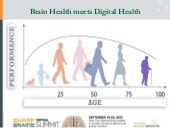
Watch Recording: 9:15–10:00am. Brain Health meets Digital Health (Recording starts at minute 41). We will discuss the key highlights and forecasts from SharpBrains’ latest market report “The Digital Brain Health Market 2012–2020: Web-based, mobile and biometrics-based technology to assess, monitor and enhance cognition and brain functioning.”
Watch Recording: 10:15–11:45am. How can organizations maximize the resilience and productivity of their human resources? Historically, human resource departments have not had the toolkit to develop the most human resource of all – our brains. What are some large employers and insurers doing to apply emerging science and best practices in this domain, via wellness and training initiatives, and HR benefits?
Watch Recording: 12:45–2:15pm. What is the future of personal brain health? Accelerating innovation is poised to enable systematic brain health self-monitoring and self-care, which in turn can transform what it means to live healthy and fulfilling lives. What concrete steps can individuals take to manage and enhance brain health and heal illness throughout the various stages of life?
2:15–3:00pm. Watercooler Chats. We’ll spend some time connecting with other participants, discussing highlights, exchanging ideas and contact information. Watch Recording: 3:00–4:30pm. How can Big Data help upgrade brain care? Current standards of brain and mental care often rely on trials of insufficient scale, which not only limits our ability to diagnose, prevent, treat and personalize care but often leads to incorrect conclusions and undesirable results. What tools and data are becoming available via large-scale web-based and mobile applications, and how can researchers, innovators and practitioners connect with these initiatives?
|
Watch Recording: 8:30–10:00am. What are scalable best practices to spread smart health? Maximizing health and well-being requires quality decision-making and positive lifestyles across millions, if not billions, of individual decision-makers. How can we accelerate the adoption of smart health behaviors in scalable and systematic ways, ensuring benefits at both the individual and population levels, and empowering consumers, patients and professionals?
Watch Recording: 10:15–10:45am. Building Up the Apollo Brain Data Exchange Portal. We will discuss opportunities and challenges arising from this core initiative, spearheaded by
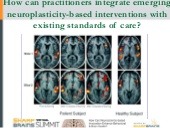
Watch Recording: 10:45–11:45am. How can practitioners integrate emerging neuroplasticity-based interventions with existing standards of care? A promising frontier of applied neuroscience lies in technologies that stimulate our brains in order to harness neuroplasticity and achieve positive outcomes. What are the practical Pros and Cons of different methodologies such as cognitive training, EEG/ QEEG biofeedback, virtual reality, tDCS, and what are appropriate ways to integrate them with traditional interventions?
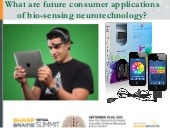
Watch Recording: 12:45–2:15pm. What are future consumer applications of bio-sensing neurotechnology? Biosensing technology is becoming increasingly amenable for consumer applications. What are existing R&D and distribution limitations and how may these be addressed over the next few years? How do we see future applications being adopted by consumers in multiple contexts?
2:15–3:00pm. Watercooler Chats. We’ll spend some time connecting with other participants, discussing highlights, exchanging ideas and contact information. Watch Recording: 3:00–4:30pm. How can innovators leverage crowdfunding and strategic investments to gain distribution reach? With distribution as a common bottleneck to the sustainable commercialization of innovation, value-added capital is often critical to enable steady progress in the translation of brain science from lab to life. This is especially true in non-medical areas, which lack appropriate infrastructure to commercialize and distribute innovative solutions. What can innovators learn from Discovery’s investment in Lumosity, AAA’s partnership with Posit Science, and Emotiv’s Kickstarter crowdfunding campaign?
|

Friday, September 27th, 2013
Expo Day
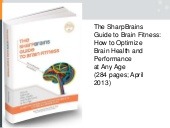 Watch Recording: 8:30–9:15am. SharpBrains. Alvaro Fernandez, presenting the new book The SharpBrains Guide to Brain Fitness: How to Optimize Brain Health and Performance at Any Age (April 2013; 284 pages).
—
 Watch Recording: 9:30–10:15am. The Alzheimer’s Research & Prevention Foundation. Dr. Dharma Singh Khalsa, presenting research and practice around self-guided Kirtan Kriya meditation.
—
 Watch Recording: 10:30–11:15am. Digital Artefacts. Joan Severson and Josh Cosman, presenting BrainBaseline app and upcoming new releases.
—
 Watch Recording: 11:30–12:15pm. Interactive Metronome. Matthew Wukasch and Kevin McGrew, presenting clinical uses of Interactive Metronome.
—
 Watch Recording: 12.30–1pm. USC Davis Center for Digital Aging. Dr. Elizabeth Zelinski, on the role of personal brain health to support healthy living across the lifespan.