
Visual Illusions in Art and Science
 The following is an excerpt from “Sleights of Minds: What the Neuroscience of Magic Reveals about Our Everyday Deceptions.” by Stephen L. Macknik and Susana Martinez-Conde with Sandra Blakeslee, published by Henry Holt and Co., LLC © 2010 by Stephen L. Macknik and Susana Martinez-Conde.
Visual illusions are fascinating. They have both been used by artists and studied by scientists. Read on to learn how art can help science understand the secrets of how we perceive the world around use.
Chapter 3. The Brother who Faked a Dome
Visual Illusions in Art and Science
Vision scientists like us seek to understand how we see, from both a psychological and a biological perspective, and our discipline has a long tradition of studying visual artists such as painters and sculptors. Scientists did not invent the vast majority of visual illusions— painters did. The visual arts often preceded the visual sciences in the discovery of fundamental vision principles, through the application of methodical— although perhaps more intuitive— research techniques.
Likewise, magicians— as the world’s premier artists of attention and awareness— have made their own discoveries. This is what drew us to their footlights, card tables, and street performances. We want magicians to help us understand cognitive illusions in the same way that artists have revealed insights about visual illusions. And in fact visual illusions are a bit like magic tricks on the page. In this chapter we’ll take a brief tour of some of our favorites.
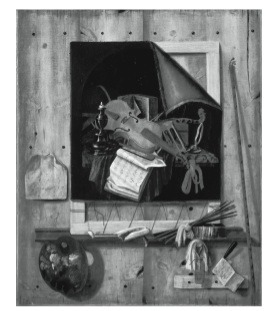
In the early decades of the seventeenth century Dutch painters developed still-life easel paintings with trompe l’oeil realism. (The Attributes of the Painter by Cornelius N. Gysbrechts. Réunion des Musées Nationaux / Art Resource, N.Y.)
Artists have been utilizing visual illusions since the ?fteenth century, when Renaissance painters invented techniques to trick your brain into thinking that a ?at canvas is three-dimensional or that a series of brushstrokes in a still life is a bowl of luscious fruit. They ?gured out linear perspective— the notion that parallel lines can be represented as converging so as to give the illusion of depth and distance. (Again, think of train tracks heading toward the horizon.) They realized they could manipulate atmospheric effects by making tones weaken and colors pale as they recede from view. They used the horizon or eye level as a reference point to judge the size and distance of objects in relation to the viewer. They used shading, occlusion, and vanishing points to make their paintings hyperrealistic.
Trompe l’oeil is a French term that means “trick the eye.” It ?ourished in the seventeenth century in the Netherlands. The lifelike pictures appeared to jump from the frame.

The “dome” of Saint Ignatius church looks like a real dome from this vantage point. (Flikr.com)
Trompe l’oeil is sometimes used on a large scale to suggest entire parts of buildings that do not actually exist. The architect of the Saint Ignatius church in Rome, Horace Grassi, had planned to build a cupola but died before ?nishing the church, and the money for the cupola was used for something else. Thirty years later, in 1685, the Jesuit artist Andrea Pozzo was asked to paint a fake dome on the ceiling over the altar. Pozzo was already considered a master in the art of perspective, and yet what he accomplished could hardly be believed. Even today, many visitors to Saint Ignatius’s are amazed to ?nd out that the spectacular cupola is not real but an illusion.
Architects soon realized that they, too, could manipulate reality by warping perspective and depth cues to create illusory structures that de?ed perception. Need a big room in one- fourth the space? No problem. Francesco Borromini accomplished just that at the Palazzo Spada, a palace in Rome that we visited a few years ago. Borromini created the illusion of a courtyard gallery 121 feet long in a 26- foot space. There’s even a life- size sculpture at the end of the archway. Not really. The sculpture looks life-size but is actually just two feet tall.
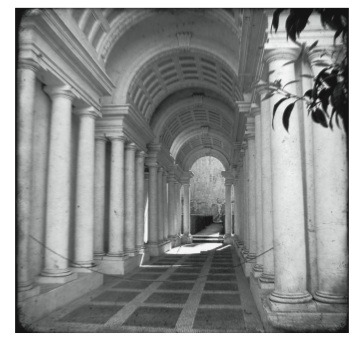
This hallway is much shorter and the sculpture is much smaller than they appear. (Flikr.com)
Closer to home and to magic is the Grand Canal concourse at the Venetian Hotel and Casino in Las Vegas. The ?rst time you step onto the concourse, you feel a sudden onset of twilight. That’s exactly what Susana’s mother, Laura, experienced when we ?rst took her to Las Vegas while planning our conference. We descended from our suite after a room service lunch. Stepping out of the elevators and onto the concourse, she said, “Oh, it’s gotten so dark outside.” Susana asked her what she meant. “The sky,” Laura said. “It’s gotten dark so early.” “But, Mamá,” Susana explained, “we’re still inside. You see the black spots in the sky? They are sprinkler heads.” Mouth agape, Laura examined the incredible illusory sky, with its ?ve shades of rococo blue— peacock, azure, cerulean, turquoise, and aquamarine— and wisps of mare’s tails, stratus, and cirrocumulus clouds. Laura considered it for a minute before turning to Susana and saying, “Well, why did you tell me so soon? I would have liked to enjoy it a little longer.”
Another great illusionist is the Dutch lithographer and woodcut artist Maurits Cornelis (better known as M. C.) Escher. Early in his career, Escher carved realistic scenes based on his observations and travels. Later, he turned to his imagination, rendering some of the most brilliant visual illusions in the history of art. When he was in high school, one of Steve’s favorite posters was an Escher print of the never- ending staircase (Ascending and Descending, 1960), in which a group of robed monks perpetually climb or descend an impossible staircase situated at the top of a temple. It was impossible because it circled around on itself and never ended. So how could it be drawn if it was physically impossible? Escher must have cheated somewhere in the print and failed to depict the proper structure of a real staircase. But Steve couldn’t ?nd it, no matter how closely he looked. He realized he should examine the structure as a whole to see if there was a small systematic warp along the entire structure that allowed for the illusion.
And that’s when Steve found that he couldn’t look at the structure globally. He could only really see one area of the staircase at a time. His vision could process the details of the staircase when he centered his gaze on a speci?c part. But when he did that, every other area of the staircase, in his visual periphery, was left in a blur. And he realized that that was how Escher must have done it: since you can see only one local area at any given time, small, gradual errors along the entire structure could not be seen with the naked eye.
This effect challenges our hard-earned perception that the world around us follows certain inviolable rules. It also reveals that our brains construct the feeling of a global percept by sewing together multiple local percepts. As long as the local relation between surfaces and objects follows the rules of nature, our brains don’t seem to mind that the global percept is impossible.
Susana’s formal introduction to visual illusions came in 1997 when she arrived at Harvard University to study under David Hubel and Margaret Livingstone. At the time, Harvard was the mecca for the study of illusions, and in fact this is where she met Steve. Not only were Livingstone and Hubel leading the ?eld in the study of illusions in the brain, but a number of Harvard psychologists were discovering an array of completely new phenomena.
As part of her postdoctoral training, Susana decided to choose a visual illusion and investigate its effects. Lea?ng through an art book, she found the perfect playground for her curiosity: op art, a ?eld that explores many aspects of visual perception, such as the relations between geometrical shapes, variations on “impossible” ?gures that cannot occur in reality, and illusions involving brightness, color, and shape perception.
Susana settled on op artist Victor Vasarely, whose Nested Squares series exhibited an odd illusion: the corners of the squares looked brighter than their straight-edged sides. But the effect wasn’t just about the lightness of the corners, because if Vasarely reversed the order of the nested squares from white- to- black (center to exterior) to black- to- white, now the corners were darker than the sides. So it seemed to be an illusion concerning contrast, and not lightness per se.
Susana searched the vision research literature and found that only a couple of people had discussed this effect previously and nobody had investigated its neural bases. And no one had looked at shapes other than squares. Squares are a special type of shape in which all of the corners are convex (all point away from the center of the square). But nobody had examined the effect for nonsquare shapes with concave corners or for shapes with corner angles other than 90 degrees. Susana realized there were many aspects of this illusion that she could study perceptually, followed by physiological research in the brain.
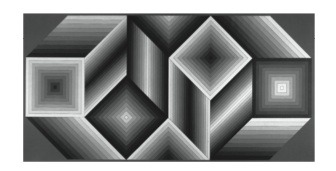
Vasarely’s Utem (1981). Nested squares of increasing or decreasing luminance produce illusory diagonals that look brighter or darker than the rest of the squares. (Courtesy of Michèle Vasarely)
After several years, ?rst as a trainee at Harvard and later as the director of her own research team, Susana learned one of the most fundamental secrets of the visual system. The previous dogma in the ?eld had been that neurons in the ?rst few stages of the visual system were most sensitive to the edges of object surfaces. Susana’s results showed instead that neurons of the visual system are more sensitive to the corners, curves, and discontinuities in the edges of surfaces, as opposed to the straight edges that had previously been thought to reign.
Op artists were also interested in kinetic or motion illusions. In these eye tricks, stationary patterns give rise to the powerful but subjective perception of illusory motion. An example is Enigma by Isia Leviant.
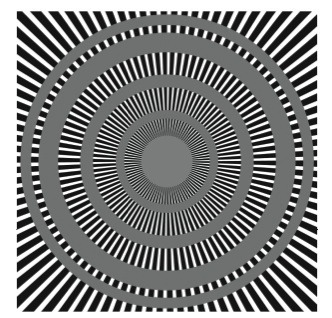
Reinterpretation of Enigma (Created by and courtesy of Jorge Otero- Millan, Martinez- Conde Laboratory, Barrow Neurological Institute)
This static image of regular patterns elicits powerful illusory motion in most of us and has generated an enormous amount of interest in the visual sciences since it was created in 1981. However, the origin of the illusion— is it the brain, the eye, or a combination of both?— remains, appropriately, an enigma.
—> Interested in reading more? Please check out the new book “Sleights of Minds: What the Neuroscience of Magic Reveals about Our Everyday Deceptions.” by Stephen L. Macknik and Susana Martinez-Conde with Sandra Blakeslee, published by Henry Holt and Co., LLC © 2010 by Stephen L. Macknik and Susana Martinez-Conde.
Share this:

About SharpBrains
Top Articles on Brain Health and Neuroplasticity
Top 10 Brain Teasers and Illusions
Got the book?