Using Brain Plasticity to help Children with Learning Disabilities
Did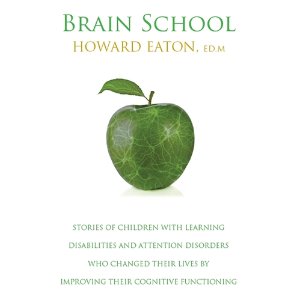 you read The Brain That Changes Itself: Stories of Personal Triumph from the Frontiers of Brain Science, the great book on neuroplasticity by Norman Doidge? If so, you will have heard about the Arrowsmith School/ Program, which was also one of the Top Ten Finalists in 2010 Brain Fitness Innovation Awards. The following is an excerpt from Brain School: Stories of children with learning disabilities and attention disorders who changed their lives by improving their cognitive functioning (November 2010; $22), a new book from Eaton Arrowsmith School’s (EAS) founder and director, Howard Eaton. It tells the story of how children with learning disabilities (dyslexia, ADHD, etc.) can overcome educational obstacles by reorganizing their brains. An inspiring book about how cognitive programs can result in both academic and social success.
From the Introduction of Brain School
Norman Doidge, in his bestselling book about neuroplasticity, The Brain That Changes Itself (New York: Viking Press, 2007), coined the term “the plastic paradox.” That is, the brain has the ability to change itself in both positive and negative ways. Neuroplasticity does not necessarily mean that the change that is occurring is for the benefit of that individual or society. For example, some forms of behaviour can become extremely debilitating, such as that seen in obsessive-compulsive disorders (ocds). For educators who work with children with disabilities, “the plastic paradox” can hinder their ability to see new possibilities. For decades, their ideas have been firmly set that children who struggle with cognitive functioning weaknesses will continue to struggle throughout their lives. The children’s caregivers must give them all the support they need to ensure they make it through school. Learned helplessness is the term used in the fields of education and psychology to describe many children with learning difficulties. In fact, this learned helplessness does not have to be the case.
Brain School asks politicians, educational administrators, psychologists, psychiatrists, family doctors, educators, parents, and others involved in education to be open to the idea that cognitive functioning can improve and the brain can change. Many educators are not even aware of brain plasticity. In education, the establishment’s common understanding is that the brain is more or less fixed; that is what many of them learned at college or university. Perhaps they have not read the latest information on brain plasticity and neuroscience. As a result, they keep practicing the same instructional remediation methods for children with learning disabilities as though they are the only options available.
I was much the same; it was not easy for me to accept that the brain is plastic. I clearly recall classroom discussions about the brain during my undergraduate education in psychology and then in my graduate program in special education. The brain was fixed, unchangeable, hard-wired like a computer. My professors were critical, almost mockingly so, of so-called radical scientists discussing the brain’s ability to change. They acknowledged that there are some formative years of brain development in early infancy, but that was it. This was my training and background. In fact, I co-wrote handbooks and produced educational videos advising parents and their children with learning disabilities to accept their cognitive weaknesses and view them in a positive light.
Barbara Arrowsmith Young has been working with brain plasticity for thirty years. Yet some educators disregard her program due to their inability or refusal to conceptualize what she is doing. These educators are so focused on improving skills such as spelling, reading, and writing that they fail to see it is the brain’s current cognitive functioning that affects these behaviours. As well, they do not see that children who fail in school are often dealing with more significant issues with reasoning, memory, auditory processing, visual-perceptual processing, visual-motor integration, and social-perception problems—all cognitive functioning weaknesses—and that these cognitive functions can be improved. Yet Arrowsmith Young has persisted and her results outstandingly speak for themselves. She is the first neuroplastician with operating schools and licensed programs in the field of education in North America.
This is not to deny that many wonderful minds in education and psychology have provided major insights into learning disabilities and attention disorders. Nevertheless, the notions that the brain can change inability or refusal to conceptualize what she is doing. These educators are so focused on improving skills such as spelling, reading, and writing that they fail to see it is the brain’s current cognitive functioning that affects these behaviours. As well, they do not see that children who fail in school are often dealing with more significant issues with reasoning, memory, auditory processing, visual-perceptual processing, visual-motor integration, and social-perception problems—all cognitive functioning weaknesses—and that these cognitive functions can be improved. Yet Arrowsmith Young has persisted and her results outstandingly speak for themselves. She is the first neuroplastician with operating schools and licensed programs in the field of education in North America.
This is not to deny that many wonderful minds in education and psychology have provided major insights into learning disabilities and attention disorders. Nevertheless, the notions that the brain can change itself and that cognitive intervention methods can be designed to improve cognitive functioning are revolutionary to many education experts, who refuse to depart from their own entrenched neural pathways. When a dramatic change of thought is presented they become uneasy and often dismissive, preferring to stick to old ways of doing things. […]
There is no magic or quick fix for improving cognitive functioning. It is difficult and tiring work for the child with learning and attention disabilities; it takes resilience and diligence to improve. Neuroplasticity does not occur without significant active engagement over a lengthy period. Not surprisingly, some critics use this as a way to dismiss this work. They say, “Why would you make children with learning disabilities work so hard? They are already struggling enough.”
.
Optimal cognitive functioning remediation for a severe learning disability, and in some cases an accompanying attention disorder, can take three to four years in a full-time school environment, which will be shown in the stories in Part II. Some of our most remarkable children persistently and repeatedly worked on cognitive exercises in order to achieve their noteworthy accomplishments and become honours students after transition to mainstream classrooms. The Arrowsmith Program’s belief is that nothing is wrong with hard or tiring work if it has an important purpose. This is how many great minds developed breakthroughs in engineering, physics, chemistry, architecture, literature, music, mathematics, medicine, and other disciplines. They spent hours going over ideas and theories. Similar to the body’s physical training, in order for the brain to become efficient at a particular task or behaviour, it must practise it repeatedly. Children with learning disabilities and attention disorders must stimulate and strengthen their brains’ ability to learn with repeated cognitive exercises in order to overcome their neurological weaknesses.
To read more:
- Brain School: Stories of children with learning disabilities and attention disorders who changed their lives by improving their cognitive functioning, by Howard Eaton
- The Brain That Changes Itself: Stories of Personal Triumph from the Frontiers of Brain Science, by Norman Doidge
Share this:

About SharpBrains
Top Articles on Brain Health and Neuroplasticity
Top 10 Brain Teasers and Illusions
Got the book?