

Football: Even “minor” hits can cause brain damage
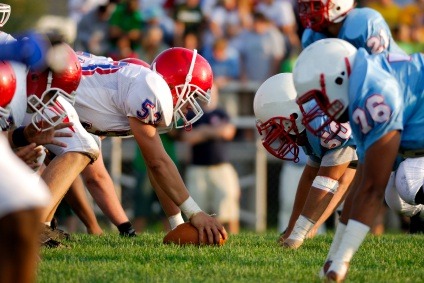 Today the American Academy of Neurology (AAN) “is calling for any athlete who is suspected of having a concussion to be removed from play until the athlete is evaluated by a physician with training in the evaluation and management of sports concussion.”
At the same time, an article in Sports Illustrated reports a new study in which Purdue researchers put sensors (accelerometers) in the helmets of 23 seniors from Jefferson High in Lafayette, Ind. Results are surprising and concerning: Hits that do not even lead to concussions can have a much bigger impact on the brain than we thought.
What are concussions?
Concussions (or mild traumatic brain injury) are the most common type of traumatic brain injury. They involve a head injury with a temporary loss of brain function.
The brain is surrounded by cerebrospinal fluid, one of the functions of which is to protect it from trauma. However this cushion is not always enough in situations involving severe impacts or merely the forces associated with rapid acceleration.
The most common symptom of concussions is headache. Other symptoms include dizziness, nausea, lack of motor coordination, difficulty balancing, visual symptoms, and ringing in the ears.
Concussions can cause a variety of physical, cognitive, and emotional symptoms. Symptoms usually go away within a few weeks, without treatment. However they may persist, or complications (such as dementia) may occur. No specific treatment exists.
Football and concussions
Some sports such as football are particularly violent and many players do suffer concussions. This problem is well-known at the National Football League (NFL). In July the NFL distributed a new poster to teams that warns of the dangers from concussions in much explicit and harsher language than the league had previously used.
The NFL also mandates that a player suffering from a concussion should stop playing if after a hit he can’t carry on a coherent conversation or remember the last play …
The new study
What about hits to the brain that do not lead to concussions?
The Purdue study reported in Sports Illustrated this week and to be published soon in Journal of Neurotrauma in part answers this question. The 23 young players who participated in the study took both the ImPACT test (a computerized test assessing memory and concentration skills) and tests of working memory while their brains were scanned using functional MRI. Working memory is the ability that allows us to hold information current in our mind for the task at hand.
Eleven out of 23 of the players were tested again at midseason. Only 3 had suffered concussions. Of the 8 who had not suffered concussions, 4 nonetheless showed signi?cant impairment in visual memory. In terms of brain activity these 4 players showed a decline in the activity of the dorsolateral prefrontal cortex (just behind the forehead) during the visual memory task.
The players whose visual memory was the most impaired “were not coming from the concussed group but from a group that in the week preceding the test had taken a large numbers of hits—around 150—mostly in the 40 to 80 G range.”
The good news is that after 9 months off from football, the impaired players returned to their baseline scores in the Impact test.
Conclusions
The new Purdue findings suggest that even hits not leading to concussions can affect the brain. Although the results come from a very small number of players and will have to be replicated, they are quite concerning.
The study involved young high-school players whose brain is not mature yet. Their brain is thus still very plastic and seem to recover quickly, after a few month without football. But what about older players’ brains that may have less ability to compensate for blows?
Previous studies have linked repeated concussion to Mild Cognitive Impairment (MCI) and dementia. For instance, Guskiewicz et al (2005) have found that retired professional players (average age of 53.8 years and an average football career of 6.6 years) with three or more reported concussions have a fivefold prevalence of MCI diagnosis compared with retirees without a history of concussion. Retirees also an earlier onset of Alzheimer’s disease compared to the general American male population.
The effects of concussions, though usually short lasting a the time of the blow, thus have long-term consequences. What about the long-term effects of those other violent hits that do not lead to concussions? Future research will tell.
Head injury is listed by the Alzheimer’s Association as one of the risk factors for the disease that we can influence. If playing football (or any other violent sport) has to be part of one’s life, awareness of the potential dangers and looking for alternatives strategies (surely celebratory helmet-knocks can be avoided?) seem worth a try!
Share this:

2 Comments
About SharpBrains
Top Articles on Brain Health and Neuroplasticity
Top 10 Brain Teasers and Illusions
Got the book?

Some very interesting information!!
I am very glad that the NFL has taken a firm stance and tackled (no pun intended) this issue head on (again no pun intended).
It really is a shame to see former athletes in such terrible mental condition after they stop playing…
Couldn’t agree more with Trijicon… The NFL is taking a stance on these types of hits and they should. The players need to be protected! However, it can be quite sad to see the former athletes and the lack of support they are getting from the NFL. Unfortunately, that is why we might see a strike next year.