

Your Trading Brain: Expert or Novice
We had the fortune to interview Dr. Brett Steenbarger on Enhancing Trader Performance and The Psychology of Trading as we launched our Neuroscience Interview Series.
Below, Expert Contributor Dr. Janice Dorn provides an in-depth brain-based discussion of the topic, concluding that “The brain is the most powerful structure in the known universe and the only trading tool that the trader needs to become an expert.”
No matter whether you are a Pro or Amateur Trader…this will certainly exercise your brain! (Dr. Dorn is preparing more articles on trading performance and the brain…so stay tuned).
This is Your Brain On Trading
– By Dr. Janice Dorn
The opening bell sounds, and sixty million traders enter the greatest arena in the world to do battle with each other. They put their money, beliefs and skills on the line as they make decisions to buy and sell. Welcome to the financial markets where billions of dollars are won and lost every day. Volatility compels all to engage their brains in the continuous process of decision making. What separates the winning from losing traders is the way they use their most powerful trading tool—the human brain.
The average time and effort required to achieve expertise in trading is 10 years and 10,000–20,000 hours of practice. Moreover, it is the quality of the practice, the complete immersion in the subject and the ability to profit through ever-changing market cycles that separates trading winners from losers. It takes a lot of falling down, making mistakes, learning, re-learning and getting up again to make an expert trader. Most of all, it takes pure passion and total commitment to the process.
How do excellent traders become that way and stay that way? How do they perceive, interpret and act on the barrage of information they receive during the trading day? How do master traders make decisions in a rapidly moving, ambiguous environment where they are confronted with massive amounts of information and data? These questions pose more questions as we attempt to understand and model the thoughts, feelings and behaviors that are patterned in the brains of successful traders.
YOUR TRADING BRAIN 101
The human brain is the basis for decision-making in every aspect of trading, from the initial desire to learn to trade, choice of trading instrument, development of trading plan, strategy and trade execution. It is the human brain that makes decisions and causes these decisions to be put into action. Trading is, from start to finish, 100% neurobehavioral, and the human brain is the most powerful trading tool. To even begin to understand what separates the excellent trader from the rest, we must look for answers within the brain. The human brain is the most powerful, complex and sophisticated information-processing system in the known universe. One hundred thousand years old and weighing about three pounds, it is a dynamic, opportunistic, self-organizing system of systems. It sits quietly inside of a closed, dark space and knows nothing except what it is told by electrochemical impulses streaming into it. The brain contains some 100 billion nerve cells called neurons (Figure 1, to the right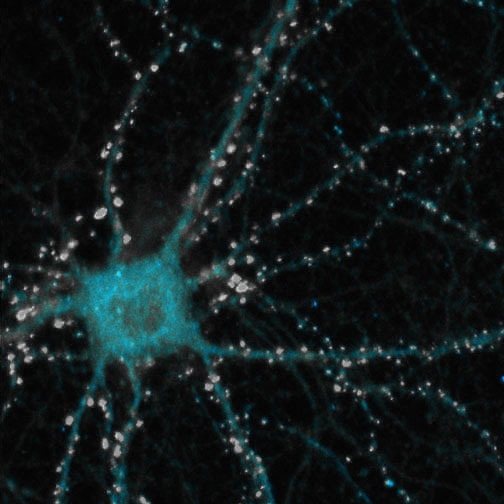 ) which branch out to form over one quadrillion connections called synapses. (Figure 2, to the left). The easiest way
  to conceptualize this is that there are more synapses in the human brain than there are stars in the known universe. Memory and learning occur when the neurons and synapses reorganize and strengthen themselves through repeated usage.
Although the exterior of the human brain is quite unremarkable with few visible landmarks, there is a long tradition of drawing the brain with labels indicating different “areas” of structure and function (Figure 3). 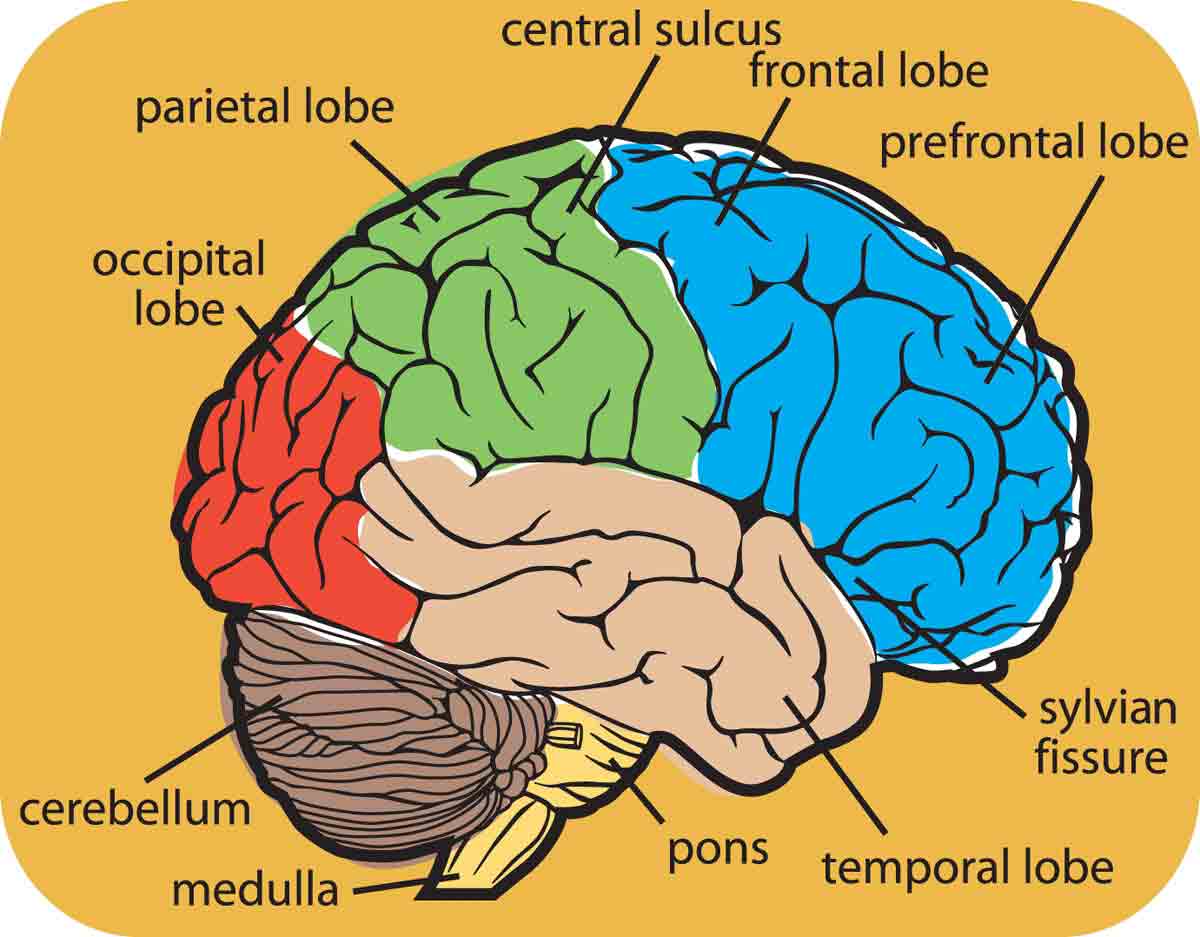 Although highly oversimplified, these offer a road map for beginning to understand brain localization and organization.
A simple map of the exterior surface of the brain. The occipital lobe serves vision, the frontal lobe is for movement and the prefrontal lobe governs higher thinking and processing.
LOOK INSIDE YOUR TRADING BRAIN
In recent years, these colored illustrations have been increasingly replaced by real-time depictions of the human brain in action. Through various neuroimagining techniques, such as fMRI (functional magnetic resonance imaging), PET (positron emission tomography) and MEG (magnetoencephalography), we have the opportunity to study the internal structure and function of the living brain in the process of carrying out various tasks, including those involving decision making for monetary rewards. Although not ideal, and still in developmental phases, these studies offer novel insights into the way the brain processes information and they promise hope for the future of unraveling the mysteries of the brain. Figure 4 (right below) is an fMRI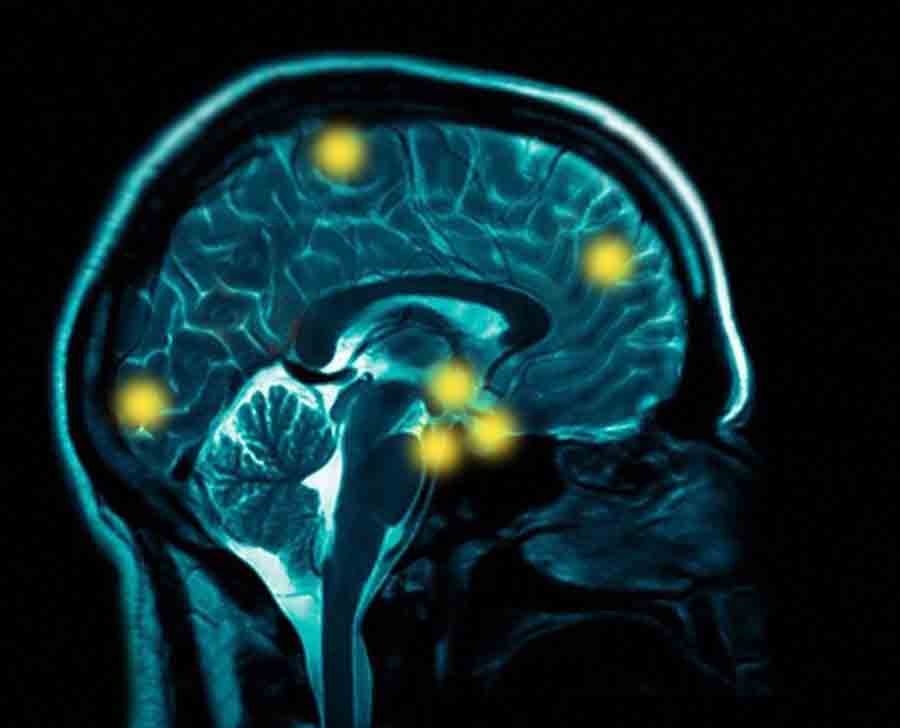 of the brain showing areas that are believed to “light up‚ i.e. become activated, in the process of making trading decisions.
THINKING AND FEELING WITH YOUR TRADING BRAIN
For our purposes, the brain has two major structural and functional divisions: the thinking brain (neocortex) and the feeling/emotional brain (limbic cortex). These two areas of the brain are in constant communication as the neocortex attempts to interpret and modulate powerful impulses from the limbic brain. Figure 5 (to the right) 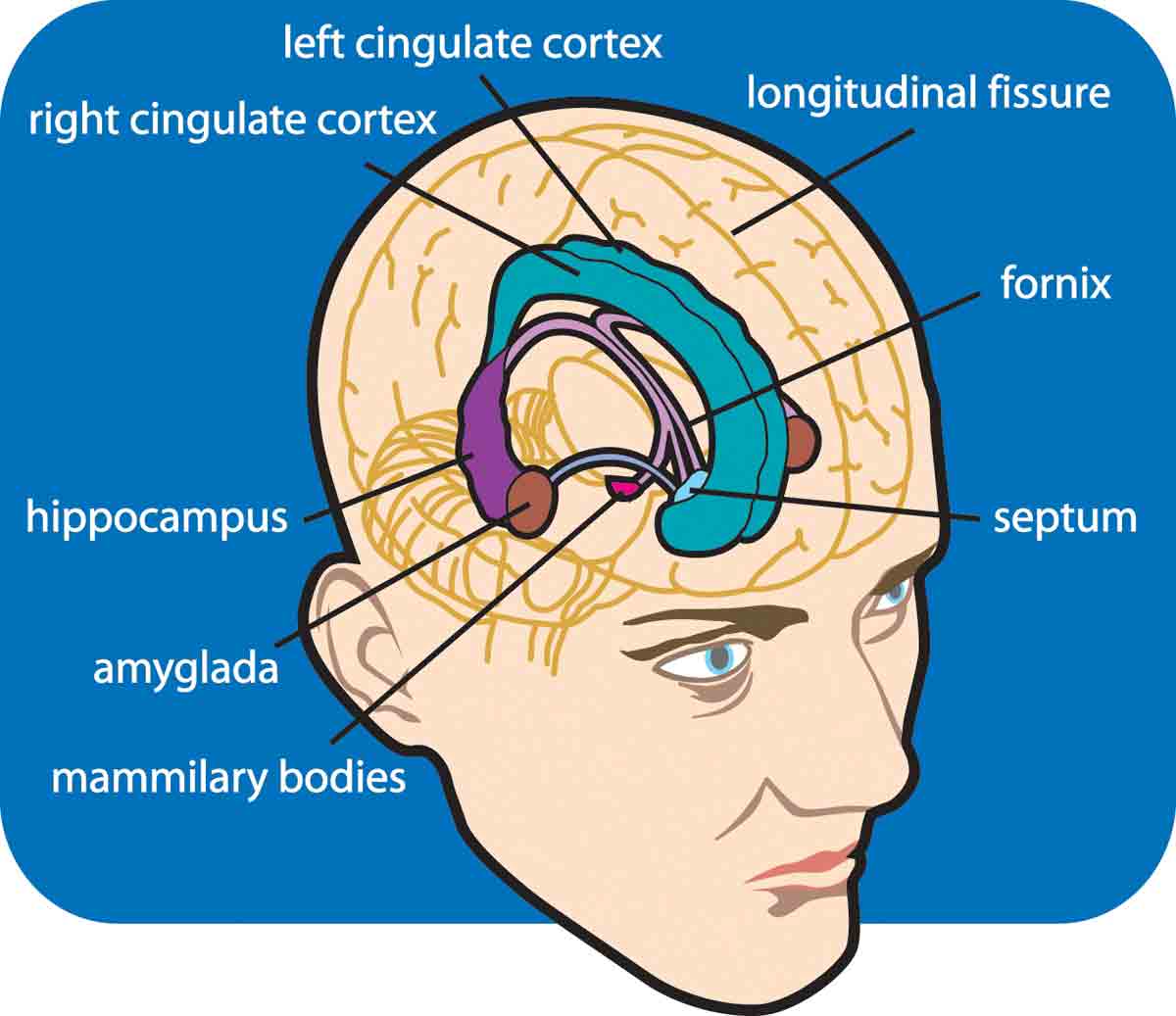 is a simple drawing of the relationship between the neocortex (beige color) and the limbic structures (shown in color).
Limbic structures such as the amygdala and hippocampus shown here in color lie deep within the neocortex (beige color). In the process of development of the brain, the neocortical areas grew up and folded over the limbic areas.
Thus, the limbic areas are called “old brain” and the neocortical areas are called “new brain.” In terms of functional decision making, the neocortical areas are reasoned, slow, deliberate, and cognitive, i.e. they think (cogitate). The limbic areas are fast, less than rational, appetitive, and not self-aware, i.e., they feel (affect). There is a constant battle going on between these two areas that may lead to agreement or conflict. Such states are called dissonance (which may be cognitive or affective) and consonance (which may be cognitive or affective).
With this basic information, we can now appreciate that the brain communicates with itself through neurons and their synaptic connections that travel up, down and laterally from one brain region to another. Moreover, the brain uses stored memories to create, recreate and recognize patterns. These patterns allow us to solve problems, make decisions and engage in effective behaviors. Crucial to this discussion is that decision precedes behavior. For example, the motor activity involved in clicking the computer mouse to send a trading order is not the decision; rather it is a behavioral response to the decision that has already been made in the brain. Trade execution is, then, the end result of a circuit of neurobehavioral processing which goes on inside of the brain.
YOUR TRADING BRAIN: SYNAPTIC STRATEGIES
With this fundamental backdrop, we may now begin to imagine the possible course of processing and communication that goes on within the brains of traders. The illustrations in Figure 6 and Figure 7 are highly simplified and incomplete. They do not show the myriad of synaptic connections, internal feedback, modulating mechanisms, partial pattern representations or temporal aspects of brain processing. They are a template from which to begin the journey to understanding that it is synaptic strategies that differentiate trading success from trading failure.
Figures 6 and 7 use visual input to the brain because the majority of traders employ vision as their primary mode of perception. One could substitute auditory or perceptual input, but I have chosen to use the visual mode. Also, I am making the assumption that the trader is using synaptic and neuronal mechanisms to visualize, interpret, process and respond to what is seen on the trading screen as a signal. The flow is as follows:
The signal is seen;
The signal is remembered or not remembered;
The signal is interpreted from a feeling (affective) of either consonance or dissonance;
The signal is interpreted from a thinking (cognitive) state of either consonance or dissonance;
Bodily reactions of excitement or calming occur;
The trade is executed or not executed.
THE EXPERT TRADER: SYNAPTIC STRATEGIES
Figure 6 shows an experienced trader who sees a signal, processes it through his brain and acts quickly to execute. 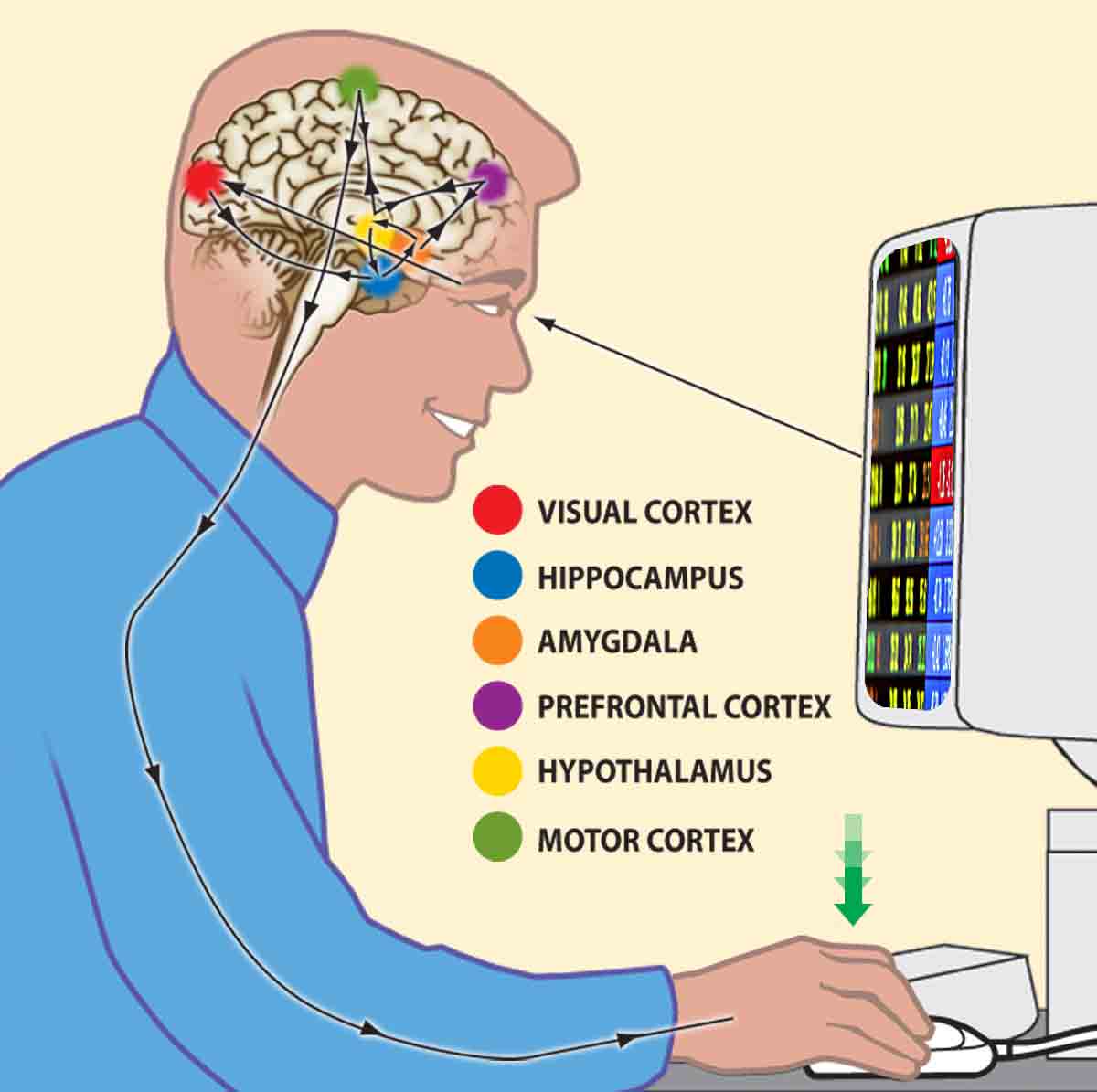 He has seen this before, has gone through the same procedure many times such that his synaptic strategies are laid down and strengthened through repeated brain training stimulation. There is little or no cognitive or affective dissonance in the course of receiving a signal, processing the pattern, making a decision and executing it.
In Figure 6 (left), the synaptic strategy is such that the signal:
- Enters the brain through the eyes;
— Goes from the eyes to the visual area of the neocortex where it is represented as a pattern;
— Travels as a pattern from the visual cortex to the hippocampus where it is remembered;
— Moves from the hippocampus to the amygdala and limbic structures where it is given affect (mood and feeling). In this case there is affective consonance, i.e. the trader feels good about the signal;
— Transmits between the limbic area and the hypothalamus to send messages to the body for calming and quieting. Although there may be some anxiety or fear involved, these tend to be minimal. Blood pressure, heart rate and breathing, which are controlled through these mechanisms, remain unchanged or slightly elevated;
— Communicates from limbic structures to the prefrontal thinking areas where there is cognitive agreement. There is little thinking time involved here and there is cognitive consonance;
— Goes to the motor area of the neocortex where the signal is sent to the hand to click the mouse;
— Is executed as a trade.
In this instance, due to repeated, constant and intense conscious practice and experience in a variety of market conditions, the trader knows and feels the possible outcome of taking the trade. His synaptic strategy causes him little if any bodily discomfort and he is aware at all times that the market could prove him wrong. He knows this from constant repetition and already has plans to exit if it does not work out. This is a winning synaptic strategy based on continual conscious practice which trains the brain in such as way as to allow the synaptic connections to act rapidly and in harmony with each other. There is little, if any, cognitive or affective dissonance.
THE NOVICE TRADER: FLAWED SYNAPTIC STRATEGY
In Figure 7, the synaptic strategy is that of an inexperienced, novice or poorly trained trader. In this case, the signal:
Enters the brain through the eyes;
Goes from the eyes to the visual area of the neocortex where it is represented as a pattern;
— Travels as a pattern from the visual cortex to the hippocampus where it is not remembered or partially remembered. The hippocampus becomes very “chatty” and starts sending the pattern up to higher and higher levels of the visual cortex asking for help in the task of pattern recognition;
— Moves from the hippocampus to the amygdala and limbic structures where it is given affect (mood and feeling). In this case there is affective dissonance, i.e. the trader feels badly about the signal;
— Transmits actively between the limbic area and the hypothalamus to send messages to the body for arousal. Physical manifestations of anxiety or fear may appear. Blood pressure, heart rate and breathing that are controlled through these mechanisms may be elevated and sweating may occur;
— Goes back and forth from limbic structures to the prefrontal thinking areas where there is cognitive dissonance. There is a lot of thinking, questioning, second guessing and internal cross-talk;
— Does not go to the motor cortex and is not executed as a trade;
— Due to lack of adequate practice or a dearth of experience in this market condition, the trader is synaptically short-circuited. There is so much going on inside his brain that the cross-talk causes both cognitive and affective dissonance. This is a state of confusion and “dis-ease”. The trade is not executed.
The process of pattern distortion or non-recognition in an inexperienced trader leads to “freezing” and not taking the trade as shown in Figure 7. There is one other possibility not shown in Figure 7 that happens with some regularity. Owing to the large amount of confusion and anxiety that is going on inside of his brain, the trader may actually execute the trade in order to alleviate his anxiety. In actual fact, this process of attempting to alleviate anxiety likely leads to more anxiety, more internal questioning and more cognitive and affective dissonance. In other words, it can become a vicious cycle that leads to losses and may be one of the reasons that so many individuals do not stay the course with trading.
TRAIN YOUR TRADING BRAIN
In summary, it is my opinion that all trading strategies and decision making are brain-based synaptic strategies. Because the human brain has an infinite capacity to change, organize and reorganize itself, progression to trading excellence is possible. It is only through intense, diligent and totally committed practice through many years and many market cycles that the trader advances to the state of disciplined excellence. This excellence is the result of training the synaptic connections within the thinking and feeling areas of the brain. As a consequence of this training, the trader will be able to recognize, process instantly and execute the trade with little or no cognitive or affective dissonance.
The brain is the most powerful structure in the known universe and the only trading tool that the trader needs to become an expert.
 For the past twelve years, Janice Dorn, M.D., Ph.D., has focused her attention on trading, mentoring and commentary in the financial markets, with emphasis on Behavioral NeuroFinance, Mass NeuroPsychology and Trading NeuroPsychology. She has traded the gold futures markets full time since 1996, and has coached and mentored over 600 traders and investors. She is the Global Risk Strategist for Ingenieux Consulting Group Pty Ltd. You can reach Dr. Dorn at The Trading Doctor. © Copyright 2007, Janice Dorn.
To learn about additional ways to use this brain research to improve trader performance, check out these relevant posts:
- Enhancing trader performance and the psychology of trading: Interview with Dr. Brett Steenbarger
- Change your environment, Change yourself
- Emotional self-regulation and biofeedback
Share this:

3 Comments
About SharpBrains
Top Articles on Brain Health and Neuroplasticity
Top 10 Brain Teasers and Illusions
Got the book?

iam a stock market trader. i am keen to know more about this amygdala and emotional hijacking during the few tense moments where sanity is most required.
Fascinating. I have traded for years and have never really thought about the neural process.
Dr. Dorn,
Thank you for unwinding the complicated choices that we make each day, especially applied to market psycho-neurology for traders. Great Contribution!