Sharp Brains: Brain Fitness and Cognitive Health News

Emwave and Emotional self-regulation
Performance FreezeFramer Alvaro

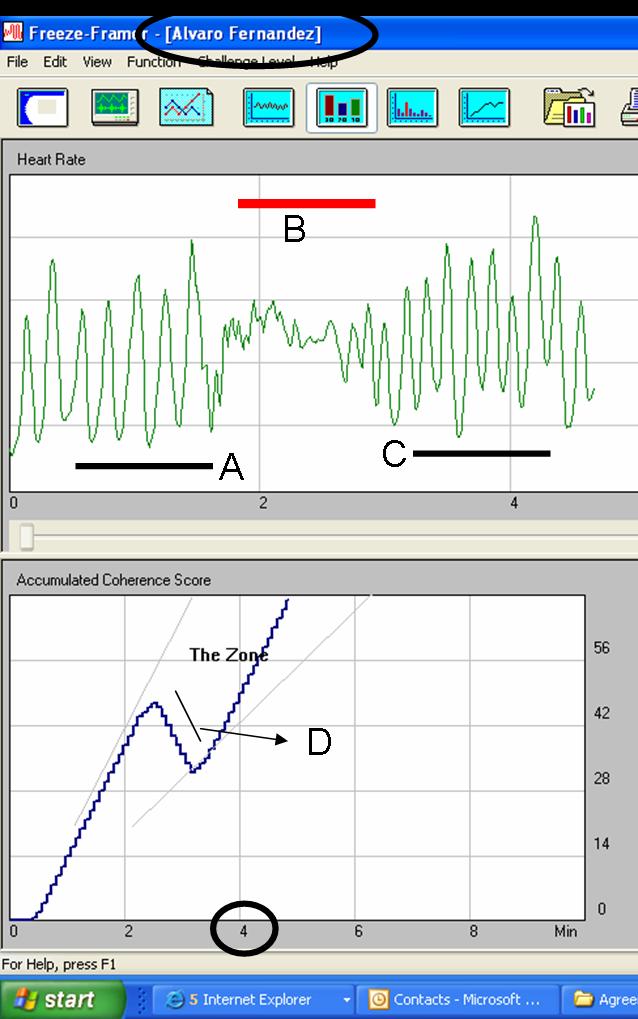
In the post Trader Peak Performance and biofeedback programs we showed the Heart Rate Variability patterns correlated with levels of a) anxiety or b) Peak Performance, “The Zone”. Biofeedback supports our emotional self-regulation: we can visually track what is going on inside us and train ourselves to manage our emotional state. On the left you have an example of my own performance during a 5-minute experiment 4 months ago. At the top, you see my name; at the bottom, the duration of the session. Right axis, for top half, is Heart Rate. (This is only the half left of the screen in the program-the right half would give you more information.) I have highlighted several phases:

A: you can see long waves following a smooth rhythm-that is the physiological “The Zone”, where I can perform at maximum level. I was using breathing and visualization techniques that are sometimes called “The Mental Game” in athletics and sports.

B: I stressed myself. How? well, maybe thinking of a previous boss, or some bad moment in my life. You see that the “waves” dissappear, and narrow erratic patterns appear instead.

C: I quickly go back into “The Zone”, using a breathing and visualization technique that works for me. There are many techniques-the virtue of real time visual feedback is that we can find what works for us. The more we train, the better we get at it.

D: the bottom half is showing the cumulative score, and whether I fall inside “The Zone”. The line goes down in the middle because it reflects my anxiety during phase B.

The biofeedback program I used is emWave PC Stress Relief (there is also a handheld device called emWave PSR). It contains several short “videogames” where you have to learn to relax at will in order to succeed. The graph above shows the monitor option-where you can see your Heart Rate and Heart Rate Variability real-time.

Enjoy,

Alvaro

Share This Page:
  • Facebook
  • Twitter
  • StumbleUpon
  • del.icio.us
  • Google Bookmarks
  • Digg
  • Reddit

Categories: Brain Fitness Industry, Cognitive Neuroscience, Education & Lifelong Learning, Health & Wellness, Peak Performance, Professional Development

Tags: , , , , , , , , , , , , , , , , , , , , , , , , , , , , , , ,

Print This Article Print This Article

26 Responses

  1. Tyro says:

    That’s wild. The verbiage didn’t conjure up much of an image, but with this screen shot I can start to see how this system may be able to live up to its promises. What a great idea.

    Does the software package include a heart rate monitor? Are there any reviews that you can point us to? What would a typical schedule look like for a new student?

  2. Alvaro says:

    Good it helped to visualize it. I had the same reaction when I first saw the visuals. It gets better when you start to see the real-time impact of your actions and thoughts on the screen-either when you are training or during any normal activity.


    The package includes 1) the software, 2) the sensor (finger one; you buy the ear-one for $25) that measures both heart rate and heart rate variability and connects to your PC, so your PC acts as the heart rate monitor. (HRV, not heart rate, is the predictor of levels of stress/ anxiety, and to measure it precisely requires an algorithm that heart monitors do not have) c) a very informative booklet on managing emotions while playing golf. We don’t have a trading-specific book, but the golf one gives a great overview of what is going on inside our bodies and how to manage it.


    Very recent review:
    http://seattlepi.nwsource.com/health/291574_biocompare09.html


    Another one in The Economist a couple of months back:
    http://www.heartmath.org/ihm-action/media-stories/soothing-software.html


    Schedule: typically, 3 or 4 times a week, for 5-7 minutes each. The key is frequent practice, so you internalize the techniques and see progress. You could also add 4-5 sessions of 15-20 minutes during the first month in order to get up to speed with the techniques and the program.


    For fun, why not also record what happens during a typical trading session, and analyze it afterwards.


    We will be adding community forums, moderated by coaches, in this website, so it will be easier to share experiences and get advice. Feel free to ask more questions.

  3. eleanor says:

    That is absolutely marvellous – stress makes you stupid!

  4. [...] UPDATE A jak takový program na biofeedback funguje … Filed under: Bounded Rationality   |   [...]

  5. [...] A jak takový program na biofeedback funguje …  [...]

  6. Alvaro says:

    Eleanor: nice to see you. “stress makes you stupid!…there is good stress but also bad one, see

    http://www.sharpbrains.com/blog/2006/10/22/is-there-such-thing-as-good-stress/

    For the bad one, I agree with your statement, both in the short-term (we can not think well on the spot) and the long-term (because too much stress inhibits learning and harms our health).

  7. [...] Alvaro Fernandez presents Emotional self-regulation and biofeedback: FreezeFramer posted at SharpBrains: Your Window into the Brain Fitness Revolution, [...]

  8. [...] Alvaro presents Emotional self-regulation and biofeedback: FreezeFramer and Enhancing Trader Performance and The Psychology of Trading: Interview with Brett N. Steenbarger posted at SharpBrains: Your Window into the Brain Fitness Revolution. [...]

  9. [...] Alvaro presents Emotional Self-regulation and Biofeedback: FreezeFramer and Enhancing Trader Performance and The Psychology of Trading: Interview with Brett N. Steenbarger posted at SharpBrains: Your Window into the Brain Fitness Revolution. [...]

  10. [...] Issue 12 of The Synapse came out this Sunday on Dr. Deborah Serani’s blog. It features a number of articles on neuroscience topics including: brain cells and neural substrates, cognitive thinking styles, Alzheimer’s, dream recall, and mental illness. Alvaro’s post on the executive function of emotional self-regulation via biofeedback is there – go check it out! [...]

  11. [...] Issue 12 of The Synapse came out this Sunday on Dr. Deborah Serani’s blog. It features a number of articles on neuroscience topics including: brain cells and neural substrates, cognitive thinking styles, Alzheimer’s, dream recall, and mental illness. Alvaro’s post on the executive function of emotional self-regulation via biofeedback is there – go check it out! [...]

  12. [...] Alvaro Fernandez presents Emotional self-regulation and biofeedback: FreezeFramer posted at SharpBrains: Your Window into the Brain Fitness Revolution, saying, “A visual example of how biofeedback can help manage emotions for maximum trading performance.” [...]

  13. [...] Alvaro Fernandez presents Emotional self-regulation and biofeedback: FreezeFramer posted at SharpBrains: Your Window into the Brain Fitness Revolution, saying, “Post on how biofeedback can be used by traders to manage emotions and reduce impulsivity.” [...]

  14. [...] SharpBrains has a post about emotional self-regulation and biofeeback. I feel that as a real estate investor, it is very important to keep in control of your emotions. When looking at a property to purchase, you need to remain calm and logical. It is too easy to get emotionally swept into a purchase, which will most-likely result in a bad investment. [...]

  15. [...] Alvaro Fernandez presents Emotional self-regulation and biofeedback: FreezeFramer posted at SharpBrains: Your Window into the Brain Fitness Revolution, saying, “A visual example of how biofeedback can help get into The Zone of optimal performance for trading and other highly-competitive fields.” [...]

  16. [...] Alvaro presents Emotional Self-regulation and Biofeedback: FreezeFramer and Enhancing Trader Performance and The Psychology of Trading: Interview with Brett N. Steenbarger posted at SharpBrains: Your Window into the Brain Fitness Revolution. [...]

  17. [...] Alvaro Fernandez presents Emotional self-regulation and biofeedback: FreezeFramer posted at SharpBrains: Your Window into the Brain Fitness Revolution, saying, “A visual example of how biofeedback can help get into The Zone of optimal performance for trading and other highly-competitive fields.” [...]

  18. [...] Here you have a related post on Best practice for top trading performance: biofeedback, and here a visual example of Emotional self-regulation through biofeedback. [...]

  19. [...] Check her post to learn more about the labeling technique. Developing mental notes can be a very powerful way to self-regulate behavior, not too different from cognitive therapy and emotional self-regulation techniques. [...]

  20. James says:

    Does anyone know of a Mac OS version or another software application like this one?

  21. Alvaro says:

    Hello James, we are not aware of any Mac OC version. There are a couple of handheld devices (one also called emWave, the other StressEraser), with similar technology, but give back less data.

  22. [...] Alvaro Fernandez presents Emotional self-regulation and biofeedback: FreezeFramer posted at SharpBrains: Your Window into the Brain Fitness Revolution, saying, “A visual example of how biofeedback can help get into The Zone of optimal performance for trading and other highly-competitive fields.” [...]

  23. Vern M. says:

    What an interesting experiment. I must confess that I could have used a portable version of one of those biofeedback  devices at a few points throughout today. I’ve seen the smaller portable versions, but for me more detail is much better.

Welcome to SharpBrains!

As seen in The New York Times, The Wall Street Journal, CNN,, and more, we are a market research & publishing firm tracking the research and marketplace for brain fitness and cognitive health. Our blog was recently ranked # 3 Analyst Blog.
News: The upcoming SharpBrains Summit is the first global and virtual summit focused on technology for cognitive health and performance. Learn more Here.
SharpBrains

Top 30 Articles

  1. Top 50 Brain Teasers, by SharpBrains Team
  2. The Ten Habits of Highly Effective Brains, by Alvaro Fernandez
  3. Why do You Turn Down the Radio When You're Lost?, by Caroline Latham
  4. Brain Plasticity: How learning changes your brain, by Pascale Michelon
  5. Top 10 Brain Fitness Future Trends, by Alvaro Fernandez
  6. 7 FAQs on Mental Exercise, by Alvaro Fernandez
  7. It is Not Only Cars That Deserve Good Maintenance: Brain Care 101, by Alvaro Fernandez
  8. Evaluation Checklist for Brain Fitness products and games, by Alvaro Fernandez
  9. MIT Event on Brain Games: Context, Trends, Questions, by Alvaro Fernandez
  10. Stress Management Workshop for International Women's Day, by Alvaro Fernandez
  11. Mindfulness and Meditation in Schools for Stress Management, by Jill Sutie
  12. Stress and Neural Wreckage: Part of the Brain Plasticity Puzzle, by Gregory Kellet
  13. How can I improve my short term memory?, by Caroline Latham
  14. Cognitive and Emotional Development Through Play, by David Elkind
  15. Judith Beck: Train Your Brain to Think Like a Thin Person, by Alvaro Fernandez
  16. Easy Steps to Improve Brain Health, by Caroline Latham
  17. Infographic: State of the Market 2009, by Paul Van Slembrouck
  18. Improve Memory with Sleep, Practice, and Testing, by Bill Klemm
  19. 10 Brain Tips To Teach and Learn, by Laurie Bartels
  20. Dr. Elkhonon Goldberg on Cognitive Training and Brain Fitness, by Alvaro Fernandez
  21. Maximize the Cognitive Value of Your Mental Workout, by Schlomo Breznitz
  22. Brain Fitness Program and Neuroplasticity @ PBS, by Alvaro Fernandez
  23. Mindfulness Meditation for Adults & Teens with ADHD, by David Rabiner
  24. Can Intelligence Be Trained? Martin Buschkuehl shows how, by Alvaro Fernandez
  25. How Strong is the Research Support for Neurofeedback in Attention Deficits?, by David Rabiner
  26. Exercising the body is exercising the mind, by Adrian Preda
  27. Brain Evolution and Why it is Meaningful Today to Improve Our Brain Health, by Larry McCleary
  28. Physical Exercise and Brain Health, by Pascale Michelon
  29. Posit Science, Nintendo Brain Age, and Brain Training Topics, by Alvaro Fernandez
  30. Sleep, Tetris, Memory and the Brain, by Shannon Moffet
Sign Up for our Monthly Newsletter:
New Subscribers Receive Free eBook: PDF of The SharpBrains Guide to Brain Fitness

Engage via Social Media

twitter_logo_header

Monthly Blog Archives